 As the sun sets on the SXSW conference for another year, we round up some of the themes that emerged.
Ethics & the Big Tech Backlash
What a difference a week makes. As the Cambridge Analytica scandal broke last weekend, the curtain was already coming down on SXSW. Even without this latest bombshell, the discussion around ethics in technology was animated, with more than 10 panels devoted to the theme. From misinformation to surveillance, from algorithmic bias to the perils of artificial intelligence (hi Elon!) speakers grappled with the weighty issue of how to ensure technology works for the good of humanity.
Activist and WikiLeaks military whistleblower Chelsea Manning spoke presciently about the dangers of mass data collection, calling for a code of ethics for software developers. In conversation with Vogue’s Sally Singer, she warned of the dangers of complacency: “We know [surveillance] is a problem. But I think everybody’s expecting somebody else to do something about it.
That somebody could prove to be government, said Mayor of London Sadiq Khan, if the industry does not do more to clean house. “Ultimately, there must be greater responsibility taken by some tech companies for the impact they’re having on the world,” said Khan, suggesting that unless platforms demonstrate a greater “duty of care” more countries might follow the German example and introduce tougher legislation.
YouTube CEO Susan Wojcicki made her move, unveiling a new feature she called “information cues” in conversation with Wired editor-in-chief Nicholas Thompson. The company plans to insert links to fact-based content like Wikipedia alongside conspiracy theory videos, in a bid to tackle misinformation. Every little helps, but tougher action will undoubtedly be required if the industry is to quell the Big Tech backlash, as forecast in our 2018 Future 100 report.
SXSW moves with the times
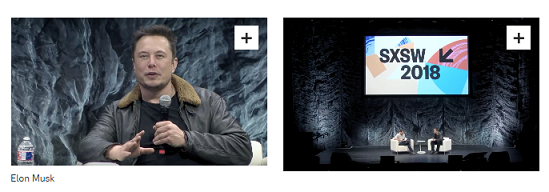
The festival also continues its evolution, climbing back from its bloated, over-commercialized state, which reached tipping point a couple of years ago, to something more considered, with a more curated line-up. As a result, the interactive swing sets placed in Palm Park for the Mercedes-Benz ME brand activation to promote its electric car initiative sat empty, as the now more serious population of attendees rushed between sessions to explore the future of technology, culture, cryptocurrency, blockchain, artificial intelligence (AI) and more. This shift in many ways mirrors the changing zeitgeist. The novelties of emerging technologies that have been venerated for so long are now, in a Brexit climate, income inequality and automation, presenting more serious challenges and questions. (Though that didn’t stop Elon Musk presenting a bombastic vision of life on Mars in a headlining, breathlessly shared talk.)
Musk made a surprise visit to SXSW this year. Only one ticket could be picked up per person, and some attendees showed up at the convention center in their pajamas, such is Musk’s continued celebrity status. Musk spoke of travel to Mars (we need to colonize it before nuclear warfare on Earth) and offered up some rather apocalyptic predictions about life on Earth and the threats of AI, stating that it is “far more dangerous than nukes.” He also continued Silicon Valley’s mantra of aiming to achieve impossible feats, alongside optimism for the future: “There are a lot of negative things in the world… There are lots of things that are miserable and kind of get you down. Life cannot just be about solving one miserable problem after another… There need to be things that inspire you, that make you glad to wake up in the morning and be part of humanity.” Presumably condos on Mars, on his part.
The Human Connection
When technology provokes this much concern, it’s perhaps natural that people should seek respite in human qualities like empathy, understanding and emotional connection.
In a standout keynote, couples therapist Esther Perel gently berated the SXSW audience for neglecting to focus on human relationships. “The quality of your relationships,” she said, “is what determines the quality of your life.
Perel, who has built a cult following through her TED talks, blog posts and her podcast series Where Should We Begin?, explained that since we left the comfort and security of village life, we have gained freedom, but lost our sense of “belonging, continuity and certainty.” We now live “a life of growing atomization,” she said, pointing to loneliness as the number one health crisis in the United States. Her solution? More conversation, deeper listening and better human connections: “We need our relationships to exist in a larger social context. We are interdependent people. No one does it alone. If they do, they don’t do it well.”
Her views were echoed by academic and sociologist Eric Klinenberg at a panel titled Sex, Love and Swiping: Tech & The Future of Love. Klinenberg suggested that our attachment to technology has affected our ability to properly engage: “We’ve come to recognize the pitfalls of being tethered to our phones,” he said, “and there’s a growing recognition of the need for better face-to-face human interaction.”
It’s this kind of insight that inspired Shawn Boyer, CEO of GoHappy, to create an app that helps you spend more time with those that make you happier by making it simple to organize real-life get-togethers. Boyer spoke on the Not Only the Lonely: How We All Can Be Happier panel, which kicked off with the radical step of asking each audience member to introduce themselves to their neighbors.
Perhaps tech can help build stronger human relationships? Over at the Panasonic House, developers shared a new concept called Famileel, which aims to help families feel connected even when apart. Famileel glows when loved ones are near it, so you can feel their presence even from afar.
But if we humans struggle with relationships, what’s a mere robot to do? Cofounder and CTO of Mayfield Robotics Kaijen Hsiao shared her learning on creating technology that modern families will happily accept into their homes. Kuri is one of a number of social robots that rely on building empathy with the user to achieve acceptance. “To make her look more lifelike, we gave Kuri the ability to smile and blink,” said Hsiao. “Expressing emotions is key to creating Kuri’s character.”
Part of our switch towards more human tech will be prompted by the rapid transition from smartphones to more immersive, intuitive interfaces that respond to visual cues or verbal orders. We charted this earlier this year in our study “The Internet of Eyes and Ears.” Amy Webb, author, professor of strategic foresight at the NYU Stern School of Business and founder of the Future Today Institute, even went so far as to predict the death of the smartphone.
Webb also talked to a packed room about the rise of cryptocurrencies. She predicted that voiceprints and faceprints will soon be our primary forms of identification. Webb noted that in China, a company called Face++ has already developed software that can determine identity through a combination of gait analysis and posture, a step beyond the thumbprints and facial recognition currently being used. This year, she proclaimed, is the beginning of the end for cellphones. “New generations of phones are offering only incremental benefits.” Webb believes that we will soon be wearing designer smart glasses, combined with smart earbuds and a digital watch or tracking band.
#IRL Experiences
Could the human factor be the reason behind this year’s breakout spectacle? Instead of amping up the techno thrills, HBO’s ambitious Westworld activation, created in partnership with agency Giant Spoon, was firmly based in good old-fashioned reality.
Westworld: Live Without Limits was by far the hottest ticket in town (including the visit of one Mr Musk) with a feverish daily ticket frenzy and a standby line that could be measured in hours rather than minutes. The lucky few were transported to the fictional town of Sweetwater, painstakingly recreated outside Austin and populated by 60 actors, half a dozen stuntpeople, horses and live bands to boot. The cast engaged visitors in a series of interactive, immersive storylines and guests even received personalized notes with prompts to draw them into the action.
Signaling the creators’ meticulous attention to detail, the script allegedly ran into hundreds of pages. The town even boasted its own currency, which could be spent in the famous Mariposa Saloon. Heightened anticipation, exclusivity and a standout analog experience combined to create an event that will no doubt see a rash of imitators next year.

Real-life human interaction still has a critical part to play in the customer experience too, even if technology can objectively do a better job, said Nike’s Sean Madden at the Physical Fights Back panel. A robot barista may be able to prepare a perfectly optimised cup of coffee, he said, but the human delivers unique value in the form of a smile and a nod. Katie Dill, VP of design at Lyft, agreed that technology is a facilitator, there to improve the experience and enable humans to deliver a better service.
Hypersensory experiences
Virtual and real-life experiences alike will be amplified with sensory cues, judging by the innovations on show in Austin.
At Sony’s Wow Studio, an installation titled Ghostly Whisper harnessed new audio technology to recreate a haunting experience in which visitors were enveloped by sound while haptics simulated the touch of something not of this world.
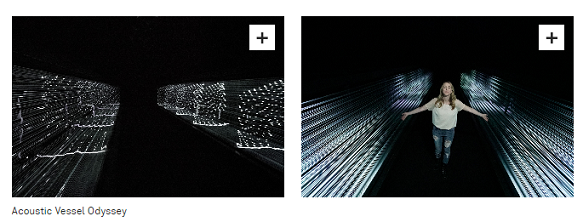
Another Sony exhibit, Acoustic Vessel “Odyssey”, presented a voyage through time and space delivered via more than 500 speakers and accompanied by a choreographed light show. Both were developed to showcase Sony’s Sonic Surf VR. This spatial audio technology enables sounds to move around, to create more immersive experiences for groups of people without the need for headphones.
Bose staged AR Hear What You See, an experience activation. The Bose prototype AR glasses had a discreet, lightweight, but effective built-in speaker that did not block out ambient sound. “This makes the user both aware of her surroundings, and available for conversation and interaction, unlike headphones,” commented a Bose representative.
London-based creative studio Marshmallow Laser Feast created a mixed reality experience harnessing visuals, sound and haptics. The piece, called A Colossal Wave!, explores the human impact on the natural world. Participants sang, whistled, clapped and hollered to create unique virtual “voice fruit,” then huddled under virtual umbrellas, feeling every splash and shudder as a mighty wave approaches.
Virtual reality (VR) artists are already exploring ways to advance emotional engagement by tapping our sense of smell (see our piece on virtual gastronomy experience Project Nourished). At a panel titled Binding Emotion & Memory: Science, Story & Scent, VR pioneer Jacki Morie predicted that in future, we will likely expect all of our experiences to have a scent dimension—not all of them sweet. Fellow panelist Saskia Wilson-Brown founded the Institute for Art and Olfaction, which has created a series of olfactory events for galleries and brands, including Roman Aromas, a permanent exhibit at the Getty Villa that recreates the scents of ancient Rome, from “laundry detergent to sweaty togas.”
More serious works of art can be found at SXSW. Now in its second year, the SXSW Art Program scattered selected works throughout the venues. This is part of a bigger SXSW shift towards highlighting the creative, immersive and storytelling aspects of technology through experiences, artist collaborations and pop-ups.
Caitlin Pickall created Feast, a multimedia installation that centered around a dining table with items projected onto it, integrating sound and video. The tabletop, plates and glasses are the surfaces for the artist’s projections.
The notion of community, and more specifically global community, is expressed in Life Underground, created by French filmmaker Hervé Cohen, in collaboration with installation artist and media designer Tonian Irving. In a nondescript meeting room at the JW Marriott hotel, visitors found three benches, placed between four screens, representing the benches on any subway car. Visitors heard and watched interviewees telling their personal stories, gathered from passengers riding on 14 different subways in different locations, including Paris, Santiago, Hong Kong and Berlin.
The extensible self
Heightening our senses like this is just one way in which we will seek to augment our bodies and minds.
The Extreme Bionics session tackled the future of human ability where “genetics, regenerative medicine, and biomechatronics” could allow us to transcend the limitations of the human body. Speakers included Hugh Herr, a professor at MIT, and Aimee Mullins, former Olympian and model. Both are bilateral amputees.
Herr, who lost his legs to frostbite when climbing, has created his own prostheses to climb again, even designing in the advantages of height or foot adjustments to suit footholds. He questions why we should be restricted by nature: in future, why not have multiple limbs? Why not wings? Mullins noted that this is a trickle-up market: in the future, the able-bodied will want to take advantage of the technology too. Those that don’t will feel they are missing out, she said: “You’re going to feel like you have the old-generation body, that you didn’t upgrade.”
On the trade show floor, Dentsu presented playful speculations on what some of these upgrades might look like. Developed by students at the University of Tokyo, Lunavity is a drone-powered backpack designed to enhance jumping ability, enabling the user to leap higher and further. Why, you ask? The team behind the device suggest it might replace wheelchairs or even create a new type of sport. Translation: they’re not quite sure yet.
It’s not just about enhancing our bodies, of course, but also our minds. Inventor, entrepreneur and futurist Ray Kurzweil summed up AI as “a brain extender” and a means to “go beyond our limitations.” Elon Musk is another key proponent of the future fusion of technology and the brain. He spoke about his Neuralink project and its goal of helping humans keep pace with AI.
For now, brain-computer interfaces are still firmly in the domain of the lab, but that doesn’t mean we shouldn’t start thinking about their potential consequences. At a panel titled Mental Work: Moving Beyond Our Carbon Based Minds, philosopher and artist Jonathon Keats talked about his attempts to make these interfaces tangible and experiential via his Mental Work installation.
The exhibit blends science, art and design to present a “factory of the future” in which “workers” must learn to control a series of machines using their brain alone. The installation attempts to provide a way for people to engage with a speculative future scenario in order to provoke wider discussion and engagement with the development of advanced technologies.
Broader debate will be essential. According to Ricardo Chavarriaga, who collaborated with Keats on the Mental Work project, one consequence of brain-computer interfaces could be the ability to encode unconscious information against the subject’s will.
Source:JWTIntelligence