
 There’s always been fascination with the tricks and tweaks that media moguls use to build and entrench their big kids’ brands and properties.
In the 1980s, US cable channel TBS scheduled its shows to start at :05 and :35 past the hour so they’d stand out in the TV Guide. Disney has long shown an incredible ability to build a ‘universe’ around its properties. More recently, Netflix has perfected the enticement to binge view, thereby dominating the viewer’s life, and the game Fortnite has managed to schedule its audience without ever needing a schedule.
Right now, in the middle of a transitional period for how audiences receive content, you have to wonder what the future of kids’ TV will look like and how current networks and brands can prepare for it.
Historically, the way to get ahead was to create, curate and schedule highly-appropriate content. Would Ted Turner’s 5-minute-shift hack work now? Probably not; in fact, there may no longer be hacks. Now, it’s all about spend (Netflix) and scale (YouTube).
The traditional media firms that used to be the glue holding generations together are now under threat from more generalist platforms, and even games like Minecraft and Fortnite.
Kids media, just like that for grown ups, has been going through a period of maturation, as it readies itself.
Globally more time is spent using a television than other screens
It’s often said that television is in decline. Indeed, there are aspects for which that’s true (to be covered in subsequent slides), but TV still accounts for nearly as much time as tablet and smartphone combined, every week. Kids’ time spent on tablets and smartphones is dominated by playing app games and watching video. As they get older, smartphone use shifts increasingly to social and messaging. On average, 8-10 year olds spend an average of 2 hours 8 minutes, and 11-15 year olds spend 4 hours 46 minutes, with social networks and messaging services.
 The decline of kids’ linear TV…
Globally, since the Spring 2016 Trends survey, linear television’s share of time has fallen by a fifth. The biggest decline in linear viewing is among 2- 4 year olds, an audience that goes largely unmeasured by television ratings services. Audience measurement begins at different ages in different countries – in the UK it starts at age 4. Amongst these pre-schoolers there has been a 25% drop in the time spent watching linear TV. Given that these young consumers of content are not developing linear viewing habits, the question is, will they ever? In our latest data, 8-10 year olds are the biggest consumers of linear television, but with a move away from dedicated children’s channels in favour of more generalist channels.
…but total video is growing
Despite a 20% decline in linear viewing, kids are actually watching more video in total. This has been driven by the rapidly accelerating growth of streaming across screens. Because kids have more access points for video than ever before (i.e. smart TVs, streaming devices, games consoles, etc.), they can get the content they want, when they want it, on whatever screen they choose – but they prefer the television. In Spring 2016, kids spent on average 10 hours 49 minutes per week streaming video. Two years later that has increased to an average of 14 hours and 8 minutes per week (up 31%).37% of time spent streaming video is on a television. This means the average time spent watching video in total has increased by 29 minutes per week since Spring 2016 to 22 hours and 21 minutes – that’s over the 3 hours per day on average.
Kids are on all devices across the week
Across ages, globally, watching television is still very much a daily habit whilst use of other devices is more sporadic during the week. However, as smartphones age-down they are becoming more of a daily habit. Smartphone activities differ from what children do on tablets. Much smartphone time goes to playing app games and watching videos, followed by use of messaging services like WhatsApp and social Networks like Snapchat and Instagram. Content makers need to consider how video will be seen; growing smartphone viewing requires repurposing content for the best small-screen experience. In use across the week, the television is still the ‘king of devices’ (just about), but many kids are as likely to be using a tablet or smartphone for entertainment, or even a games console.
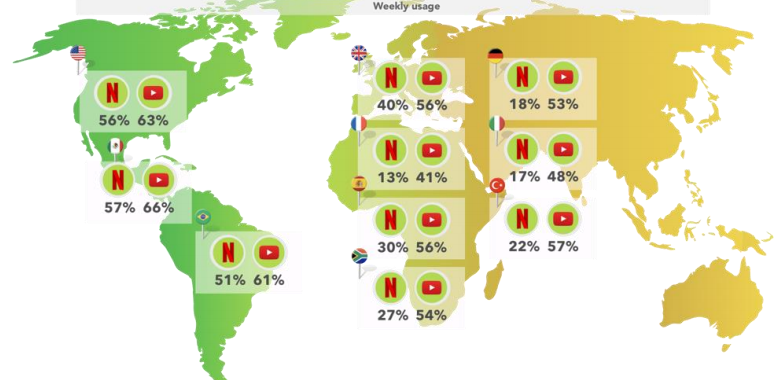 YouTube is everywhere, but Netflix dominates SVoD
Netflix has commissioned and acquired a large library of kids content. In English speaking markets it is the dominant SVoD player, generally ranking second in terms of weekly use behind YouTube. In non-English speaking areas, it’s somewhat less used by kids. Often, this is due to a lack of locally-commissioned content. Dubbing something from English into a local language is no substitute to something that originates in a country with strong social and cultural values.
Media owners are fighting back
Netflix and YouTube are now so far ahead of legacy media brands and channels; with their massive content libraries and, in the case of Netflix, budgets. They have become the dominant players for video on tablet and smartphone. Netflix announced just recently plans to borrow another $2bn to fund original content. It’s going to be hard for broadcasters to lure kids from Netflix to their own platforms.
Despite having access to massive amounts of content everywhere and anytime, children still complain they can’t readily find new things they love. They (and their parents) want content curators, and this is where broadcasters have an advantage. They are skilled at curating and promoting scheduled. If Netflix showcased its children’s content in a free and curated unique app for under-13s, it would be a huge concern for broadcasters. With fewer TVs in households, children are coviewing shows with parents. This has the effect of ‘aging down’ generalist channels. Broadcasters need a new content strategy to keep kids in the driving seat on the big screen.
Humour is the genre most kids like
Across all ages, “funny” ranks as the most liked genre. Action/adventure is second most popular (driven by 8-15 year olds). Kids of all ages love animals and wildlife – at the younger end this is likely to be can be YouTube videos of kittens playing, while older kids watch content like Shark Week on Discovery. Music covers a host of content types, from nursery rhymes and sing-a-longs at a young age to music videos and concerts for teens. Amongst pre-teens and teens, sci-fi/fantasy and sport come to the fore, and teens move into mystery/thriller and scary/creepy stuff. As kids get older, they develop personal passions and interests, and this is reflected in their preferred entertainment genres, which begin to diversify.
Factors influencing kids content consumption
While we often talk about “quality content,” it appears that today’s young audiences don’t interpret quality the same way industry does. Kids focus less on production values and more on whether they relate to the content. A broadcaster will spend a number of years creating a new show. It will be developed with a strong narrative, defined characters and have brand consistencies. In contrast a YouTuber is sitting in a ‘cupboard’ producing, launching and getting feedback on a video within 24 hours. So every 24 hours they are learning more and more about their audience. One effect of this learning is that they iterate it back into their content. So in the one year that a kids’ channel brand takes to produce a series a YouTuber has produced 365 pieces of content and had 365 ‘conversations’ with their audience base. In contrast kids channels don’t have a single real data point. Ratings don’t help a broadcaster, as they aren’t received until several dozen episodes are in the can. Like a race between the tortoise and the hare. However, there is only 1 tortoise but millions of never resting hares.
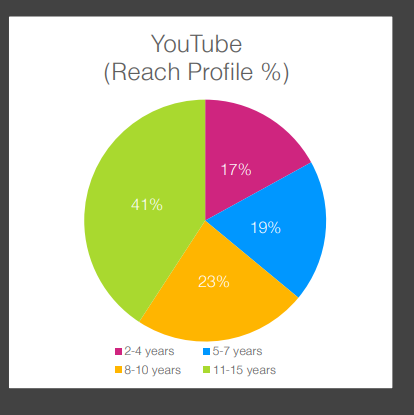 The importance of accessible peers
Now that YouTube has overtaken TV for teens (and is heading that way for younger kids), it can be hard to understand why YouTubers have such a powerful hold over kids. An individual with a webcam and internet connection doesn’t have the same editorial guidelines and production constraints as TV companies. They can comment instantly on news or pop culture; they can even take their fans on holiday with them. Parents may not see the appeal, but for kids it’s all about being in the moment. Many offer some type of expertise that kids are interested in, such as style tips or video game strategy – knowledge that provides social currency with friends or on the playground.
Parent and children use videos to discover arts and crafts ideas, leading to quality time together, inspired by the screen. If a kid can pick up a tip from a YouTuber on how to complete a level in a game before a school-friend, then it was time well spent.
Concluding thoughts
1. Kids don’t flick through the channels
There was a time when kids would flick through the channels with a remote control, looking for something they wanted to watch and pausing when they saw something familiar or interesting. This was how they often found new shows/series. Now, with so many access points to video content they want to watch, they less often come across new shows or casual interests. It means new shows need more signposting at the times they are watching and on other media.
2. Generalist content aging down
Fewer televisions in households means families are coming together more often to watch a show. Often it’s reality TV or ‘shiny floor shows’ but not always. Natural history series like Planet Earth II are great examples of other generalist successes. Lifestyle series like the BBC’s Top Gear have successfully facilitated ‘dad and lad’ time. More recently we have kid extensions of reality series, e.g. The Voice Kids and Junior Bake-off. Thus, kids are spending more time with generalist shows on generalist channels. If these kid extensions were found on kids channels, perhaps families would come together to watch them there.
3. The importance of breadth and depth
One criticism of streaming services is they’re all ‘cartoons’ with no texture. Curated channels have the advantage not only to time content to the available audience, but also to blend genres and formats. They mix animation and live-action so as to ensure one format doesn’t dominate. Recently, linear channels have been behaving like SVoD services, with marathons and take-overs, but the result is that the channel no longer demonstrates the breadth and depth of content that kids love.
4. The importance of heritage
Not all the content kids engage with is new. A new property only proves its success if it can sustain for over time. Brands that have been around 10, 20, even 50 years are as loved by today’s kids as they were by their grandparents. In the past, heritage brands nearly always started in film, toy or TV. But as digital brands like Angry Birds mature, increasingly heritage brands will have a digital origin. Heritage brands are important because they have the ability to facilitate occasions when parent and child come together.
5. There’s much to learn from video games
Game franchises have the power to captivate audiences. Fortnite, like Pokemon Go and Minecraft before it, fast became a cultural phenomenon. There’s a lot legacy media can learn from this game that satisfies kids’ needs so readily. It’s ‘snackable’ (there’s another game starting in moments), it’s social (you can interact with friends), it’s familiar (it borrows the best elements of other games) and it balances scarcity and ubiquity (like streaming, you’re never more than moments from what you want).
Authored by Adam Woodgate,Senior Research Manager at Dubit Limited.
Source: MIPTV-MIPCOM