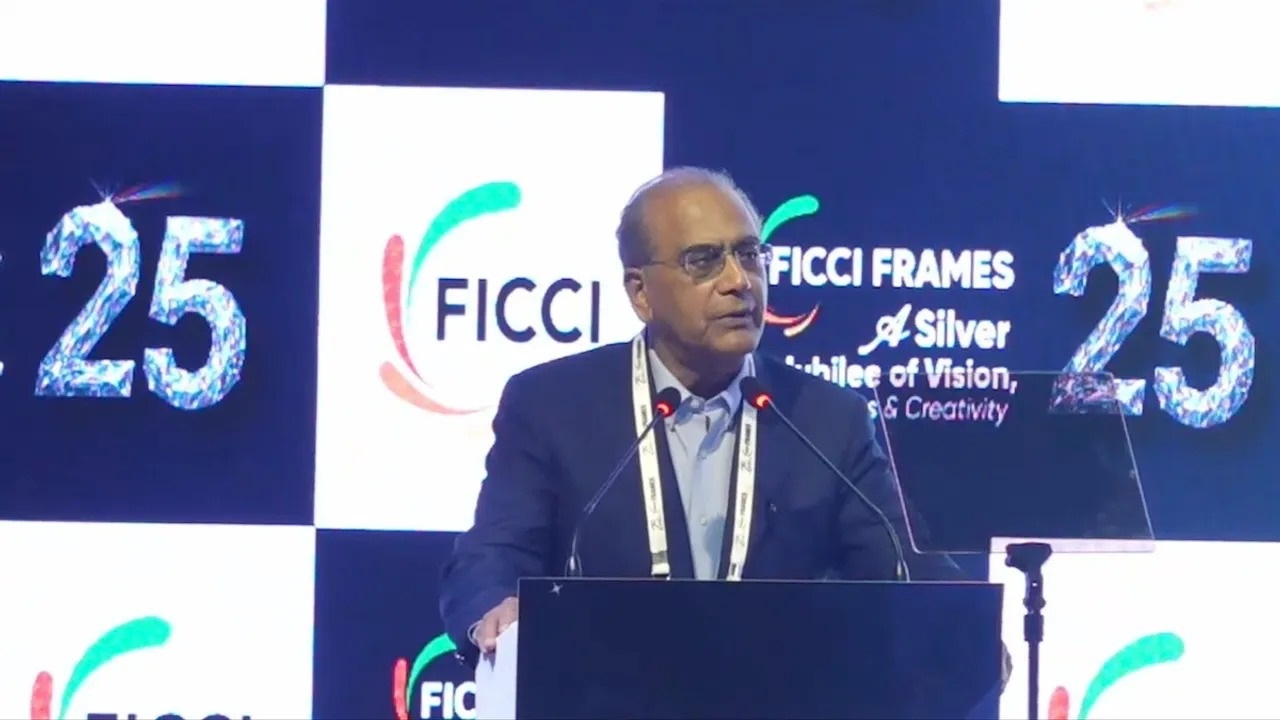
The ballroom at FICCI Frames 2025 was alive with energy as media barons, streaming giants, startup founders, content creators, and policymakers gathered under one roof. When Aroon Purie, Founder and Chairperson of the India Today Group, stepped on stage, the atmosphere shifted.
At 79, Purie has witnessed the evolution of Indian journalism from the rise of print in a newly liberalising nation to the explosive growth of satellite television, the chaotic promise of digital media, and now the unnerving emergence of artificial intelligence. “Disruption is not the enemy, it’s the new normal. The real question is—do we have the courage, imagination, innovation, resilience and integrity to seize it?” he said, his voice calm but firm. His address was not a nostalgia trip but a reality check, blending history, critique, and a call to action for the country’s media industry.
Purie painted a picture of Indian media unlike any other in the world, noting that there are 1.4 lakh registered publications, over 900 satellite TV channels, and more than 375 news channels. Cities like Delhi wake up every day to a staggering mix of English and regional newspapers, yet beneath this impressive scale lies fragility. The business of news has always depended on someone else paying for it. Print runs on what Purie called “raddieconomics,” newspapers priced so low that their resale value often exceeds the purchase price. Television broadcasters struggled from the beginning with carriage fees, and even digitisation could not resolve structural weaknesses. TRAI’s price controls, intended to make television accessible, ended up throttling the market. “It is beyond my understanding why the government treats cable TV as an essential commodity whose price they must control like wheat or rice. If the truth be told, the government has made a mess of the broadcasting industry due to lack of foresight and regressive policies,” he said, highlighting the economic vulnerability of the system.
He was equally candid about the editorial consequences of this fragile model. The real paymaster of Indian media, he pointed out, is not the reader or the viewer but the advertiser, both corporate and government. For decades, this model has been both a blessing and a curse. It enabled mass distribution of news at ultra-low costs, fueling literacy and democratic discourse, but it tethered journalism’s survival to balance sheets rather than public trust. “When journalism’s survival depends almost entirely on advertising, its independence is under a constant threat of compromise,” he said. Editorial priorities increasingly bend to commercial pressures, and the space for dissent shrinks not because of overt censorship but because uncomfortable stories are bad for business. Adding to this challenge is the rise of what Purie calls “Billionaire News Channels,” networks owned by industrial conglomerates for whom news is a tool of influence rather than a profit center. “This must be the only business where 99% of news channels lose money, yet there’s still a queue of people wanting to enter,” he quipped, drawing knowing laughter from the audience.
Digital media changed everything at breakneck speed. If print and television were slow-moving tectonic plates, digital was a tsunami. But in the scramble to ride this wave, Indian media repeated an old mistake by giving content away for free. “Digital news was our chance to fix the model. But we chased scale and eyeballs, and in doing so, handed over power to the new gatekeepers—Google, Facebook, YouTube, and Twitter,” he reflected. These platforms control distribution and monetisation and now take more than 70% of total media ad revenue. Digital advertising has surged ahead, making up 55% of the entire ad pie, far surpassing print and television combined. “The old master was the advertiser. The new master is the algorithm,” Purie said. Algorithms do not reward accuracy, nuance, or truth. They reward outrage, speed, and virality. Editorial meetings are increasingly dictated by what is trending rather than what is important, and SEO specialists often wield more influence than senior reporters. The newsroom has become a battlefield for attention, not ideas.
Artificial intelligence poses the next challenge and perhaps the most unsettling. AI can summarise articles, answer questions directly, and scrape original reporting without credit or compensation. In this future, users may never even click through to the original source. “This is an existential threat to the very creation of credible information. What happens to the organisations that pay reporters and fight court cases when their content is scraped and regurgitated for free?” he warned. If digital disrupted distribution, AI threatens the very act of journalism itself.
Despite these challenges, Purie’s message was defiant. He urged the industry to reclaim its value and champion subscriptions not just as revenue streams but as democratic acts. “We must stop apologising for the value of what we create. Credible, well-researched news is a public good and like any public good, it has a price. It cannot be free. A subscription is not just a transaction; it’s a vote for the kind of media you want to exist,” he said. Aroon Purie’s journey mirrors that of Indian media itself—ambitious, chaotic, and standing at a historic crossroads. From the print revolution to AI-powered disruption, each wave has demanded reinvention. “Ultimately, we are storytellers. And humanity survives on the stories we tell each other. In an era of post-truth, telling the truth matters even more. The future of truth and the health of our democracy depends on it.” As applause filled the room, his message resonated powerfully. The battle for the soul of Indian journalism is far from over; it is only entering a new chapter.