 The films of Amit Dutta are a rare thing in Indian cinema: They prefer to look at the world.
MUBI’s series The Inimitable Image: An Amit Dutta Retrospective is showing summer and autumn 2020 in India.
Blinking is a matter of rhythm, and so is staring—rhythms perhaps more crucial to cinema than to any other medium. By withholding perspective, or by rendering it immobile, blinking and staring introduce duration to a cinematic frame, allowing the camera to grasp the very tactile rhythm of its own gaze and that of its object. Amit Dutta’s is a cinema that is built around such rhythms, around the purely ocular movement of the eye, where gazing is everything—it is the source of both meaning in the story and of truth, if there is one. The rhythm of his cinema alternates between rapid disturbances, like in the tilt of a head, and long stretches of stillness where a landscape, such as sloping mountain road, is introduced even before it is inhabited by characters. What Dutta effectively achieves in almost all his works, ones that have gained him the reputation of being “the most famous Indian filmmaker you may have never heard of,” is a new grammar of gazing. The aesthetic and narrative impulses of this grammar share little with the Indian arthouse cinema of the 80s and 90s, many of which, like Dutta’s work, focused exclusively on provincial life but did almost nothing to alter the commercially-accepted model of social realist drama. On the other hand, Dutta’s cinema has even less in common with the commercial Hindi cinema of the recent years, even the best examples of which are interested only in reproducing the theatrical resources of acting, plotting, and drama with little or no attention to how camera, to adapt Bresson’s precept, can be used to see something singular, something that as a visual experience remains absolutely unique to the person looking. Dutta’s cinema, interested as it is in looking rather than narrating or dramatizing, taps into this unique visual experience, an experience belonging both to him and to the characters he chooses to see the world through.
Dutta graduated from the Film and Television Institute of India, Pune in 2004, after which he directed a wide variety of short films, including Kramasha (To Be Continued, 2007), which was included by Jonathan Rosenbaum in his thousand essential films of all time. In a film that is not more than 25 minutes, Dutta manages to pack a visceral range of childhood memories, personal fantasies, anecdotes, family histories, the history of village it is set in, mystical visions, semi-religious rituals, and borderline hallucinations. Shot on 35mm, the film moves with a dreamlike montage, delivering in an even tone the most bizarre details about the village, a place that everyone in India would recognize almost immediately but no one would claim to have lived in it. As a place it is poised between reality and illusions, between a history and mind-bending mythology that the narrator attributes to himself and his family. At several junctures in the film, the figure of the father and the godman try to apply checks to the narrator’s chimerical version of reality, but this exposes the narrator to even further reveries: “Keep your intellect to yourself, father growled at me one day. From then on, I have kept it to myself. Have even purchased a small brass box to store it now.” Taking slightly after Kamal Swaroop’s Om Dar-B-Dar (1988), popularly described as “the great Indian LSD trip,” Kramasha remains one of the most enchanting depictions of childhood, yoking together rural legends, easy pataphysics and a quashed teenage rebellion.
Building on some of the promises and stylistic achievements of Kramasha, Duttacame out with two feature-length films, Aadmi ki Aurat aur anya Kahaniya (The Man’ Woman and Other Stories, 2009) and Sonchidi (The Golden Bird). Both resist any realistic notions of development or narrative and here Dutta again employs a cinematic grammar of dreams, apparitions, and, not without irony, misrecognitions that guide the lives of his characters and the relationship they forge with the world. Both the films depend heavily on what the protagonists may or may not have seen, and thus the camera remains committed to making their visions and their blindness its own. Breaking many implicit bylaws of narrative cinema in India, Dutta makes no attempt to conform the outrageous perceptions of his characters inside a longer and more cohesive story. As an audience, all one is presented with is the part-enigmatic, part-troubling gaze of the protagonists. That is their story. Dutta’s cinema draws its meaning, its movement, from this singular gaze, making visible a plane of reality that without this gaze would not have existed.
“Without precursors,” is how Dutta is described in the catalog for the 2007 International Short Film Festival Oberhausen, one of the first European film festivals to recognize his work and at which he won the FIPRESCI prize. It is a fair assessment given the kind of context he draws from is variegated and his affinity with these contexts, if any, is at best oblique. The Soviet director Sergei Parajanov, however, can definitely be cited as an influence. Parajanov, whom Tarkovsky praised for his “paradoxical” and “poetical” vision, defied what was then USSR’s favored model of expression—social realism— to imbue his films with a folkloric and symbolic wisdom. There is almost an anarchic quality to Parajanov’s arrangements in a film like The Color of Pomegranates, which progresses with almost no dialogues and where each frame tries to explore a different aspect of Armenian life in the 18th century. The relationship with Dutta becomes much more striking in the comment Parajanov’s makes about his own film being a “Persian miniature” and his aim to explore the “the forms and dramaturgy of color.” Dutta’s recent films, the highly-regarded Nainsukh (2010) and The Seventh Walk (2014), are both based on lives of Indian painters and try to recreate the dynamism of color and gaze of their painterly subjects. The Japanese master Hiroshi Teshigahara could be another likely context for Dutta’s last few films. This is particularly true with regard to films such as Antonio Gaudi, where Teshigahara’s camerawork tires to replicate the bold and sensual curves of the Catalan-architect Gaudi’s own structures, again without any help from dialogues or narration. Unlike most of Dutta’s earlier films, which either had a voice-over or a consistent narrator holding them together, Nainsukh follows its subject with almost negligible dialogue. Another tradition one can also assign to Dutta’s cinema, and his immersive interest in northern Indian aesthetic traditions, is one represented by the Indian auteur Mani Kaul, who was teaching in FTII around the same time Dutta was a student there. Among Kaul’s radically innovative works is a film like Mati Manas (1985), a masterpiece of poetic documentary, which dwells much like Dutta’s own cinema in the mythopoesis of a place and its community. In the case of Mati Manas, the mythology is that of Indian pottery and its metaphysical relationship with mud or clay. What ties Kaul and Dutta together is not just their sensitive appreciation of Indian arts. Theirs is not a venture of superficial involvement that documents and records an older art form; rather, they share a discipline or an effort to create a cinematic space, a site, that can possibly receive the immense corporeal and spiritual traits of the subject at hand. One of Dutta’s finest films, Nainsukh, is a wager in that very direction.
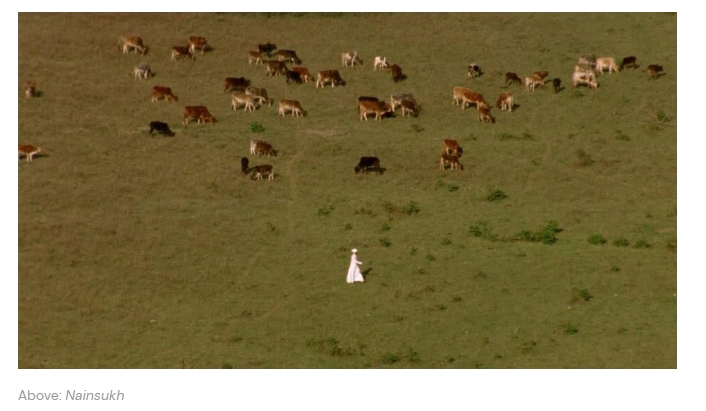
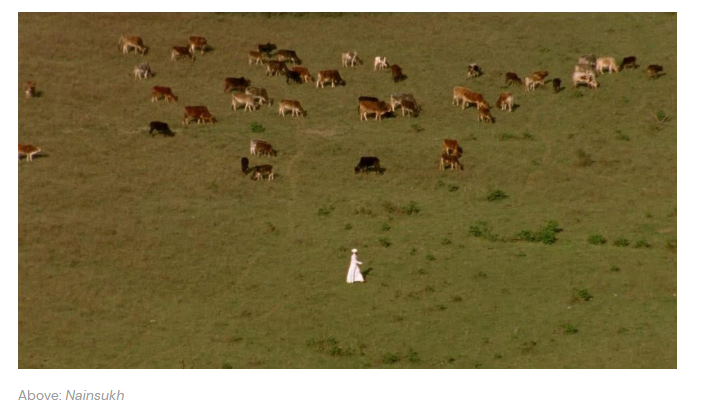
Since 2007, Dutta has collaborated with the art historian Dr. Eberhard Fischer, researching Pahari miniature painting in the Kangra Valley of Himachal Pradesh, a state in north India. Some of this research culminated in Nainsukh, depicting different stages of the 18th century Pahari painter Nainsukh’s life and the life of his royal patrons. The film situates Nainsukh in the Pahari miniature tradition, a tradition he in many ways reinvented when he moved away from religious tropes favored by his brother, Manaku of Guler, and decided to instead paint secular and rather mundane scenes from the royal court. These paintings, and their attendant minuteness, serve not just as a backdrop or an ekphratic device for the film, they rather structure the film and how each scene in it unfold. Unlike most feature films about painters, in Nainsukh one hardly sees Nainsukh with a brush or smudges of paint on his hand. Those literal conceits are given up in Nainsukh in favor of the camera learning the very movement of the brush; Dutta slowly filling landscape with details rather than making waiting and looking the central approach to the film. Drawing from Nainsukh’s paintings, most of which focus on his patron’s rich courtly life, Dutta does not just tell a story or record an event, he rather lingers in the details of the erstwhile painted surface: grassy corners, niches, hand gestures during a performance, shaky movements of a palanquin or men brandishing rifles.
Talking about Nainsukh in an interview with the critic Shubhra Gupta, Dutta mentions a “pure, beautiful rhythm, like the works of Bresson in Balthazar. In Nainsukh I only wanted rhythm, I wanted to attempt to create what I saw in the paintings.” This rhythm is executed quite tactfully in Nainsukh, and on some occasions quite brusquely, like in the scene where Balwant Singh’s barber is disrupted by a flying pigeon while trimming Singh’s beard. The camera hovers in the vicinity moving rapidly between the fluttering random movement of the pigeon and the watchful, precise movement of the scissor near Singh’s face. Throughout Nainsukh, the gaze of the Nainsukh the painter, of the eye behind the camera, and the gaze of the audience strike a unity, and these gazes purport a rhythm of their own. This rhythm is not interested in causality or establishing narrative codes, rather it is interested in waiting and looking at how color and shape relate with different emotional, social, and political fragments of our everyday life. One can either wait with Nainsukh and look, patiently, or look away, as does Manish Soni, the actor playing Nainsukh, in the final shot of the film.
Sourece:Mubi