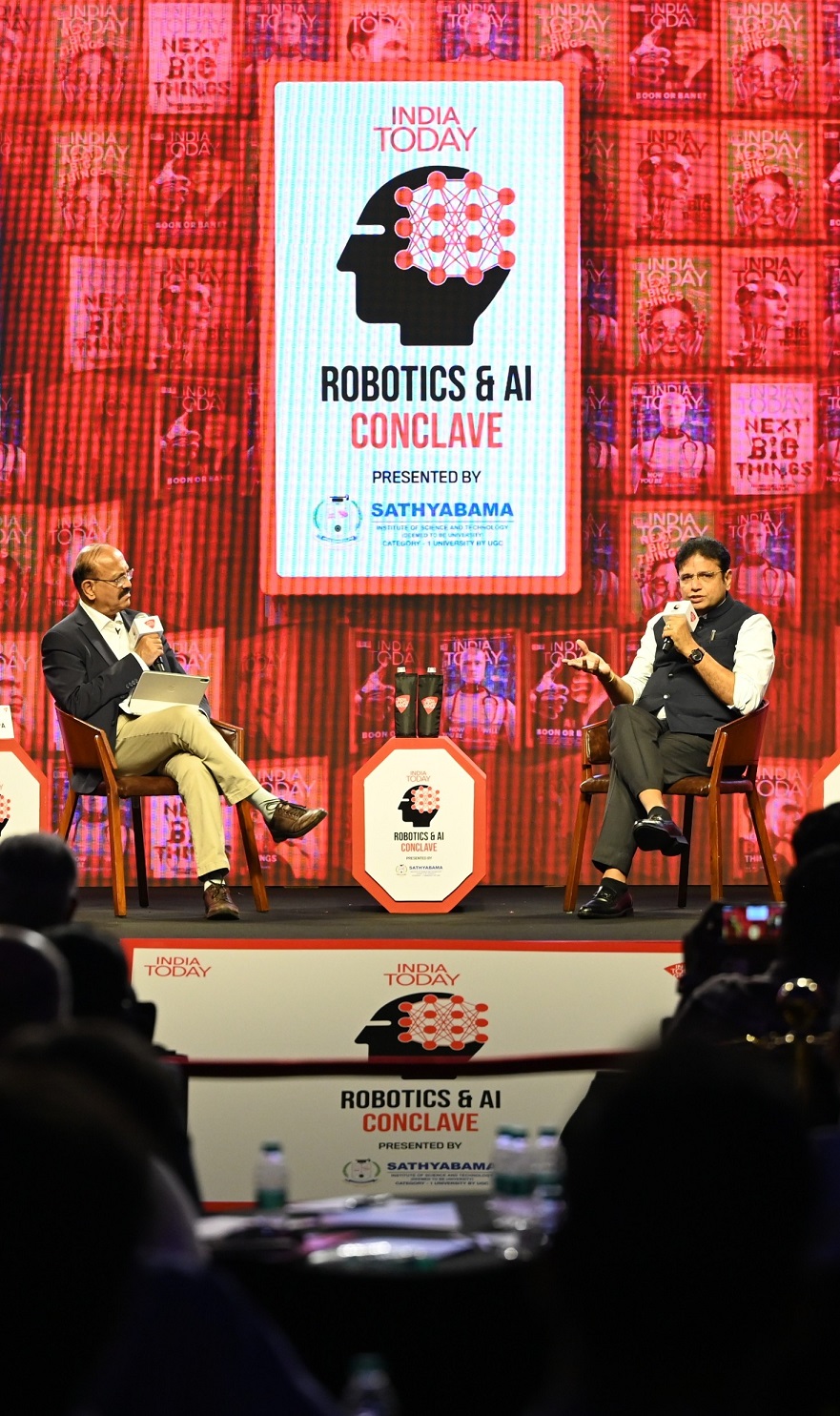
The main lesson I took from the India Today Robotics & AI Conclave in Hyderabad on Nov 6 is that India should prioritize developing an AI-literate society over creating its own foundational AI model. This conclusion was consistently reinforced across all sessions, whether focused on policy, job markets, or technological applications like prosthetics.
At Hyderabad, this came through most clearly in the jobs debate. The question is no longer “Will AI take our jobs?” but “Will we learn fast enough to work with it?” Rajiv Gupta, Managing Director at BCG, set the tone with complex numbers over hype. Citing a BCG–NITI Aayog study, he noted that 1.5 million of India’s 8 million tech jobs are vulnerable to automation. Still, as many as 4 million new AI-enabled roles could be created, potentially expanding the tech workforce to 10 million if India plays its cards right. The message was blunt: the pie is growing and being reshaped.
Then came the line that stayed with me: “I am the last generation of having made a career out of being a generalist,” Gupta said. The comfortable “smart generalist” is giving way to specialists who go deep in areas like AI safety, prompt engineering, healthcare AI, and data governance.
India will feel this sharply, as millions of engineers and BPO workers shift from generic profiles to AI-literate, specialised roles. Jaspreet Bindra drove the point home with a warning: “It’s not AI that is going to replace you, but a human being using AI who could.” The most productive people I see in Silicon Valley are not fighting automation; they are letting AI draft, debug, and design alongside them. The same will be true in India: the real divide will be between AI-augmented workers and everyone else.
This shift from job-loss fear to upskilling urgency means India’s challenge is not to avoid AI but to harness it at scale. As Dr E. John Bruce noted, AI can be a “powerful job creator” with entirely new professions emerging, but only if the country invests thoughtfully in reskilling and makes AI literacy as basic as English in education and training. If that happens, AI will not replace Indian workers, it will amplify them, from teachers and small businesses to young engineers and entrepreneurs, and governments like Telangana’s offer a glimpse of how to support this, with IT Minister D. Sridhar Babu urging India to “make the bread” instead of “exporting the flour” and backing it by modernizing 65 Industrial Training Institutes with robotics and upskilling workers in Global Capability Centers.
If the jobs and policy conversations were about scale, the startup stories brought the focus back to something more basic: dignity. One of the most decisive moments was listening to Pranav Vempati, founder and CEO of MakersHive, describe the process of building KalArm, India’s first fully functional bionic arm for amputees. The project began with a sentence from an amputee that stopped him cold: “I don’t even have basic dignity in life and you’re talking about big fancy words like dreams.” It cut through the jargon and reminded me that at its best, technology is about whether someone can pick up a glass of water, shake a hand, or write their name.
KalArm, developed in India and far more affordable than imported prosthetics, is a direct answer to that dignity gap. For me, that story captures what India can uniquely get right about AI. Any model is useless without context, and India has plenty of it, from crowded hospitals to small businesses running on thin margins. The country’s real opportunity lies in applied, context-rich AI that solves challenging local problems at a price people can afford, not in winning a race to build the biggest model.
All these threads on jobs, policy, and tech for good lead to a larger question: should India be racing to build its own giant AI model right now? After listening to the conclave, my answer is no, not yet. It is not that India should never develop a home-grown foundational model; it is that doing so as a first move risks becoming a prestige project that absorbs capital and attention without changing daily life. Training a state-of-the-art model is hugely resource-intensive; what Hyderabad underlined for me is that the more urgent investment is in people, not infrastructure.
That is why I believe India’s first national AI project should not be a model at all; it should be a generation of AI-literate Indians. In practice, that means broad, affordable access to today’s best tools like ChatGPT and Gemini for students, workers, government, and startups, and bringing AI into classrooms and training centres as a basic skill: how to ask good questions, check answers, and integrate AI into code, analysis, and writing. It also means helping entrepreneurs plug into advanced models through partnerships and credits, so they can build Indian products on top of world-class infrastructure instead of waiting for a perfect domestic model. If India does this well, it will gain what matters most in the near term: an AI fluent workforce, a portfolio of proven use cases in Indian contexts, and a much clearer view of where an India-specific model would genuinely add value.
With one foot in Silicon Valley, I also see an opportunity for India to learn from others’ experiments. The Valley is already living through the upheaval, trying things, doubling down on some, quietly abandoning others. India does not need to copy any one playbook. It can treat Silicon Valley as a live lab, borrow what works, avoid what does not, and design its own path that fits its scale, institutions, and priorities.
About Author :
Anmol Aggarwal has worked in AI and machine learning for over a decade in Silicon Valley, focusing on the practical and economic implications of advanced technologies. He has published peer-reviewed work on AI fairness and algorithmic pricing, contributed to emerging research on intelligent systems, and evaluates submissions for international technical conferences. His writing explores how AI transforms work, opportunity, and innovation.