

 The impact of artificial intelligence (AI) on the future of jobs is usually discussed in theoretical terms. Reports and opinion pieces cover the full spectrum of opinion—from the dystopian landscape that leaves millions unemployed, to new opportunities for social and economic mobility that could transform society for the better.
But the impact of AI on jobs is not just theoretical any more—it’s very much part of our present. The World Economic Forum’s The Future of Jobs 2018 takes a look at how today’s jobs are being transformed by the introduction of new technologies. Data on the skills that millions of members report on LinkedIn can give us additional insight into how AI is impacting different industries and job functions globally.
Our research into emerging skills around the world shed light on a few growing trends:
• AI skills are among the fastest-growing skills on LinkedIn and saw a 190% increase from 2015 to 2017.
• Industries with more AI skills present among their workforce are also the fastest-changing industries.
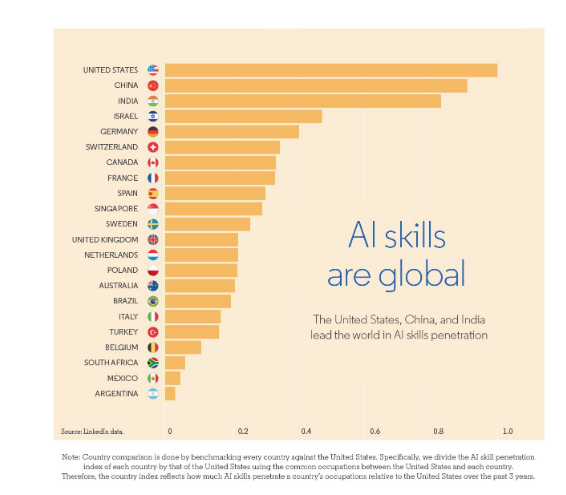
• The countries with the highest penetration of AI skills are the United States, China, India, Israel, and Germany.
Our findings suggest that while changes driven by AI technologies may still be in their infancy, we are already seeing their impact across the global labor market.
Building momentum across industries
In 2017, the number of LinkedIn members adding AI skills to their profiles increased 190% from 2015. When we talk about “AI skills,” we’re referring to the skills needed to create artificial intelligence technologies, which include expertise in areas like neural networks, deep learning, and machine learning, as well as actual “tools” such as Weka and Scikit-Learn. LinkedIn data shows that all types of technical AI skills are growing at a rapid pace around the world.
As culture and tastes change and new technologies are created, industries and jobs evolve accordingly. One of the ways to measure these evolutions is by how the skills needed for different jobs are changing. These changes propagate through occupations and industries in different ways. In some cases changes are driven by the nature of jobs or tasks changing, such as, say, an accountant focusing more on human-centric customer service tasks and less on routine tasks which have been automated—or a marketing specialist focusing on search engine optimization (SEO) to make their company’s blog content easier to discover via a Google search. In other cases, specific skills become more important to a job as they bring productivity gains—such as a data specialist using new programming and machine learning skills to more effectively target clients and ultimately generate revenue. When we compare all the different skills held by an industry’s workforce in 2015 vs. 2017, it’s clear which industries have changed the most by how much their overall skills makeup has changed.
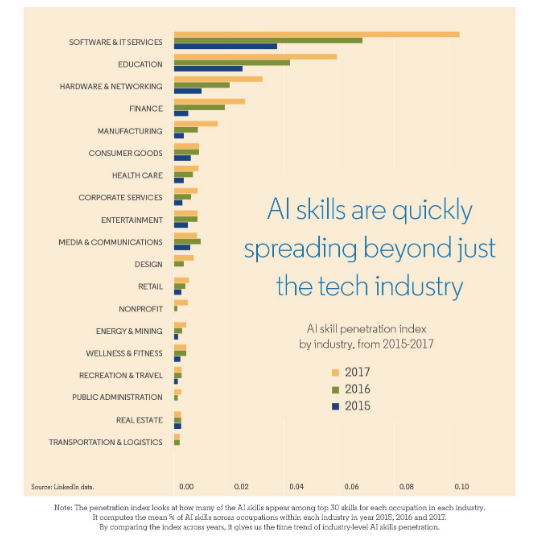
As it turns out, the industries with the most AI skills present in their workforce are also the industries that are changing the fastest. If we consider “change”to be a proxy for innovation, then this indicates that the presence of AI skills correlate strongly with innovation within an industry. It also means there’s an opportunity for many industries to invest more heavily in their AI capabilities.
When we zoomed in from the industry level to the skill level, we found that many of the changes were due to a rise in (1) data and programming skills that are complementary to AI, (2) skills to use products or services that are powered by data, such as search engine optimization for marketers, and (3) interpersonal skills. It’s a compelling illustration of how technology affects an industry. Directly getting incorporated into products is part of the impact, but the bigger impact is through complementary products and services.
 Still Niche…or Universal?
Researchers predict that AI will have applications across nearly every sector—from construction to financial services and beyond. To understand the extent to which AI skills have spread beyond the software industry, we took a look at year-over-year growth of these skills across industries. While the software industry does continue to stand out as the top field for professionals with AI skills, growth is also strong in sectors like education and academia, hardware and networking, finance, and manufacturing.
When it comes to volumes in particular, the education sector stands out as the industry where the second-highest numbers of core AI skills were added by members in 2017—suggesting that the growth of AI is correlated with more research in the field.
 Human and machine, everywhere
Artificial intelligence technologies are more ubiquitous than many people realize—and that’s true on a global level. The United States, China, India, Israel, and Germany rank as the countries with the highest penetration of AI skills among their workforce.
This growing ubiquity raises philosophical questions on the nature of how we relate to our work on a human level. As AI skills become increasingly relevant, we wanted to better understand whether typically “human” skills—e.g., those related to personal characteristics, interpersonal communication and cognitive skills—are on the rise as well. Our findings may not come as a surprise: at least for now, interpersonal skills aren’t going anywhere.
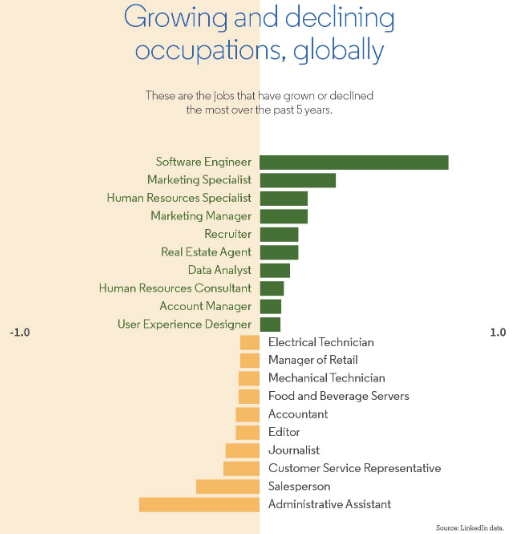 In the World Economic Forum’s The Future of Jobs 2018, we found that a number of human-centric occupations fall into the top ten most emerging occupations—i.e., occupations which have seen the most growth in hiring over the past 5 years. Globally across all industries, top emerging occupations include Marketing Specialists and Managers, Human Resources Specialists and Consultants, and User Experience Designers. These roles require an understanding of human behaviors and preferences—a skill set which fundamentally can’t be automated.
In addition, a number of highly automatable jobs fall into the top ten most declining occupations—i.e., occupations which have seen the largest decreases in hiring over the past 5 years. These occupations include Administrative Assistants, Customer Service Representatives, Accountants, and Electrical/Mechanical Technicians. As the OECD notes, the risk of automation increases if educational attainment and skill levels for a role are generally low, and roles such as food preparation assistants, cleaners and helpers, and labourers in mining, construction, manufacturing, and transport are at highest risk of automation.
As the world continues to invest in AI technologies, we’ll continue to assess their externalities and impact on the workforce, especially as it relates to opportunities for more effective reskilling and education initiatives. As new skills emerge, governments, educational institutions, and employers should consider how they are creating learning programs to equip people with the new and changing skills that are needed to keep up with the modern economy.