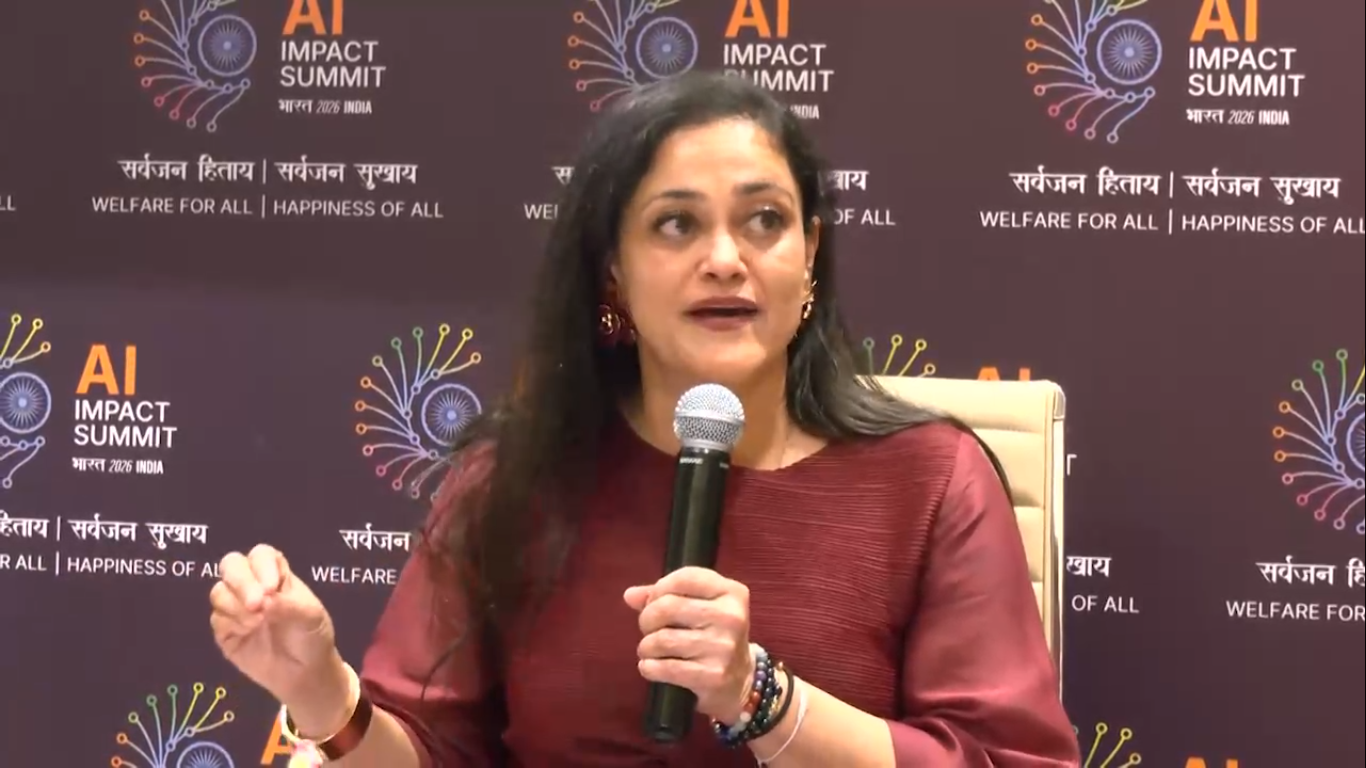
At a moment when artificial intelligence is rapidly reconfiguring the information economy, Kalli Purie, Vice-Chairperson and Executive Editor-in-Chief of the India Today Group, delivered one of the most pointed interventions at the India AI Impact Summit.
Addressing media leaders at Bharat Mandapam, Purie articulated a nine-point charter designed to embed fairness, accountability and reciprocity into AI’s expanding role in news media. Her message was unequivocal: journalism cannot be reduced to “raw material” for large language models without enforceable safeguards.
Journalism as a Democratic Infrastructure
Speaking at the session AI and Media: Opportunities, Responsible Pathways, and the Road Ahead, Purie positioned journalism not merely as content, but as democratic infrastructure. “Fair value for journalistic content is non-negotiable,” she asserted, calling for transparency in how AI systems “digest and metabolise” news output.
In a country as socioeconomically diverse as India, she argued, verified news brands carry institutional responsibility. “News and credible media shape opinion. That responsibility must rest with accountable institutions, not anonymous algorithms,” she said.
The Nine-Point Framework
Purie’s proposed charter outlines structural correctives for the AI-media equation:
1. Fair value for journalistic content, with transparency on AI usage
2. Traceability and attribution as democratic principles
3. Recognition of journalism as a public good
4. Rewarding socially impactful stories
5. Proper valuation of verified institutional content
6. Severe penalties for AI hallucinations
7. Correcting asymmetry in reward and punishment between legacy media and social platforms
8. Treating citizens’ attention as finite capital
9. Reciprocity from major tech platforms — if they extract value from journalism and attention, what do they return?
The charter reflects growing global concern that AI systems disproportionately benefit from professionally produced journalism while redistributing economic rewards elsewhere.
The ‘AI Sandwich’: Human-Led, Tech-Enabled
Importantly, Purie clarified that the India Today Group is not resisting technological adoption. The network has integrated AI tools for over two years, deploying AI anchors, cloned voices and AI-assisted storytelling formats.
However, she described the organisation’s operating philosophy as an “AI sandwich”:
Human intent at inception, AI as augmentation, and human editorial authority at closure. The formulation underscores a principle increasingly debated in global media governance — that accountability must have a human custodian.
“We don’t want to become one biscuit in an AI cookie-cutter world,” she remarked, reinforcing the need for editorial sovereignty.
Warning Against ‘Digital Imperialism’
Purie also introduced a geopolitical dimension to the discussion, cautioning against what she termed “digital imperialism.” Her concern: global technology platforms often impose standards asymmetrically, benefiting from Indian reportage without proportionate economic or structural reciprocity.
Indian journalists invest in on-ground reporting, verification and risk-taking, she noted, yet AI summaries and influencer ecosystems frequently monetise derivative content without cost-bearing.
Her call for a sovereign AI stack, centred on consumer trust and institutional accountability, signals a policy direction aligned with India’s broader digital autonomy ambitions.
Industry Convergence
The intervention reportedly resonated across the room. Leaders from prominent national dailies and media houses indicated support for formalising such a framework, suggesting that the summit may mark the beginning of a coordinated industry position on AI governance in media.
The Larger Stakes
Purie’s concluding warning carried strategic weight: if journalism is hollowed out in the AI transition phase, rebuilding institutional credibility later will be exponentially more difficult.
Her nine-point charter is less a defensive stance against AI and more a structural blueprint — one that seeks to ensure that as artificial intelligence scales, it strengthens rather than destabilises the foundations of verified news.
For Indian media, the AI debate has clearly moved beyond experimentation. It is now about economics, ethics and sovereignty — and who ultimately safeguards the public’s trust.