
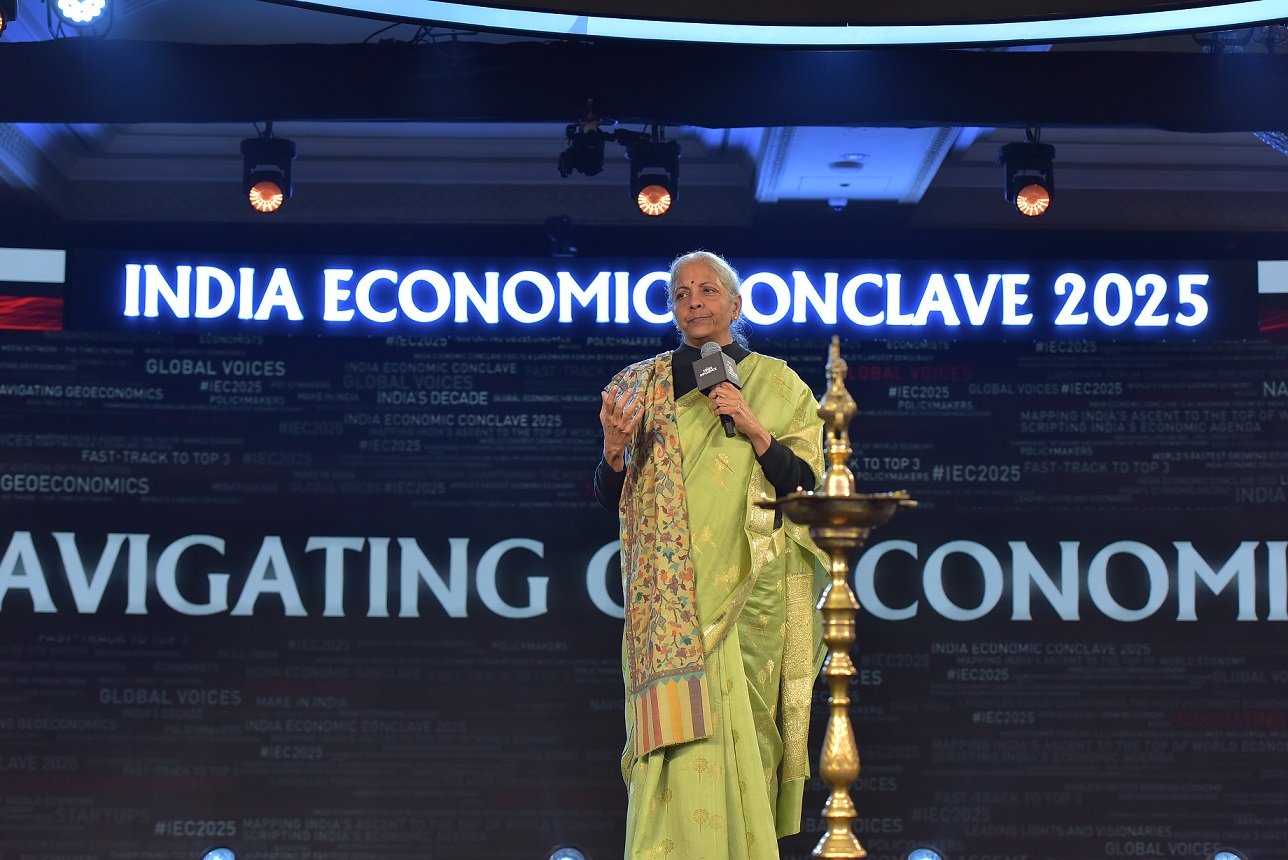
The organizers of the Times Group, particularly you, have made this a calendar event, and some very thoughtful working discussions happened during this event, just in time for me to get some inputs before we freeze the budget for each year. It’s well-timed, and this year’s theme, “Navigating Geoeconomics,” is a very contemporary and relevant topic. I can see the list of speakers, but for India, it poses challenges as well as opportunities, as we can harp on the strengths that we have.
Navigating geoeconomics as a bright spot of growing fast with steady growth, keeping growth at that level every year—is something the people of India are achieving. Each one of us, as much as all political parties and critics, should recognize it, because that’s the credit that must be given to the people of India. Much against all predictions, COVID or no COVID, people just didn’t sit back; the resilience of India is the story that all of us must stand by and help facilitate for the next several decades.
It is important for us to understand that trade is no longer what we used to talk about in global trade norms. India is looking inwards with too many barriers, and countries like India, since post-independence, want to answer people and respond to people. While it’s a very good thing to hear advice, countries like India with aspirations must mark their own goalposts, not in denial or defiance of good advice, but by chalking their own growth story. This gives the confidence that you’re building on your strengths and have the ability to meet challenges.
In the last 10 years, the kind of growth, reform, and strengthening of every sector—financial inclusion, getting women to participate in the workforce, giving nutrition and childcare, ensuring families have access to finance and banking, providing basic minimum insurance for common citizens at a government-worked-out premium that’s not burdensome, affordable housing, water in villages, roads connecting small entrepreneurs to highways, and basic minimum health (not just allopathic but wellness and holistic health)—all this has happened. I’m not saying it didn’t happen earlier, but it was fragmented and scattered; there was no aggregation. You couldn’t think of areas like Wayanad, Malappuram, Ernakulam, or Thrissur cashing in on natural rubber supplies to make footballs bought worldwide.
That’s the kind of entrepreneurial mastery we can facilitate. The same applies to sports equipment from Jalandhar, which meets global standards, supports the local economy, and aspires to scale up. Tirupur can be another story. These stories are all over the place, which is good—democratically spread local innovations. But it’s gradually moving toward collective benefits nationwide, whether copying China or learning from Europe; those experiments have happened.
What we’ve seen in the last 10 years is that wherever entrepreneurial spirit exists, we should back it and give it strength—not force everyone into an SEZ to prosper. Copying lock, stock, and barrel from other national contexts has created more problems than solutions. I’m not denying SEZs’ role in promoting exports, but it’s equally important to empower entrepreneurs wherever they are.
That’s why our government, under Prime Minister Modi, focuses on MSMEs and clusters: wherever they are, we’ll provide facilities for growth.
With inclusion, credit access via Mudra, financial inclusion, and everyone having accounts, every Indian’s credit footprint has grown, enabling formal bank credit. I’m saying this because we can aspire to an India that contributes 25% to world trade—25% of global trade emanated from India. That’s the target for Viksit Bharat: revive manufacturing, agriculture, value addition, and the service sector (which grew to over 60% of GDP on its own, despite minimal government presence—not just IT, but tourism and hospitality).
The policy framework ensures every sector gets facilitation to grow at its pace while aspiring higher. Structural reforms have played a big role: equipping primary schools with Atal Tinkering Labs, innovation centers in tier-2/3 colleges—all requiring center-state coordination. Prime Minister Modi is known for fiscal management.
The central government has set goals of transparency in budgeting, ensuring fiscal management meets accountability standards. We’ve brought down debt-to-GDP from over 60% post-COVID; it’s declining, with debt reduction as the core focus next financial year (fiscal deficit remains a marker). Entrepreneurial bankers note the changing ecosystem.
Equity gets attention; we’re deepening the bond market for funds beyond equity. The Union government’s discipline under Prime Minister Modi’s steady leadership—now in its third term—enables India’s global positioning to negotiate at the high table. This strength comes from stable government. At this Times Network India Economic Conclave, with state representatives, I said in Parliament yesterday: fiscal management priority must be understood by all states as a principle we uphold yearly.
RBI documents and studies show worrisome debt-to-GDP in some states (unnamed here or in Parliament). Unless managed within FRBM limits and high-interest debt reduced, states borrow to service loans, not development—a poor fiscal play. This threatens the 10-year momentum for Viksit Bharat by 2047. The service sector’s 60% GDP contribution is admirable, but manufacturing must accelerate, with innovation and R&D critical—globally 70% private; in India, just 36%.
Private sector R&D adds value. There are allegations and charge from the Opposition that despite corporate tax cuts in 2019, capacity isn’t expanding—they’re profiting without investing. That’s an unfair criticism. That reduction was necessary and businesses have to grow in the country. Prime Minister Modi supports corporations for jobs and GDP. Questions are being asked about why they can’t invest more which is fine as they will take their call.
Globally, trade isn’t fair or free. India faces lectures on being inward-looking or a “tariff king,” but tariffs are weaponized—India safeguards against dumping, yet others face no criticism. This is the new normal; India must negotiate carefully, leveraging economic strength.
This conclave should foster open discussion on India’s economy. As a responsible government, we share industry support for small, medium, big sectors. Don’t undermine people’s achievements by constant criticism— they’ve toiled, supported by banking, policy, taxation. Within 12 months, direct/indirect tax benefits and simplified income tax (post-1961) show rapidity; people understand and mandate accordingly.
Frustration from those without mandates undermines this. I’ll hear new ideas for budgetary/non-budgetary interventions. Thank you.