
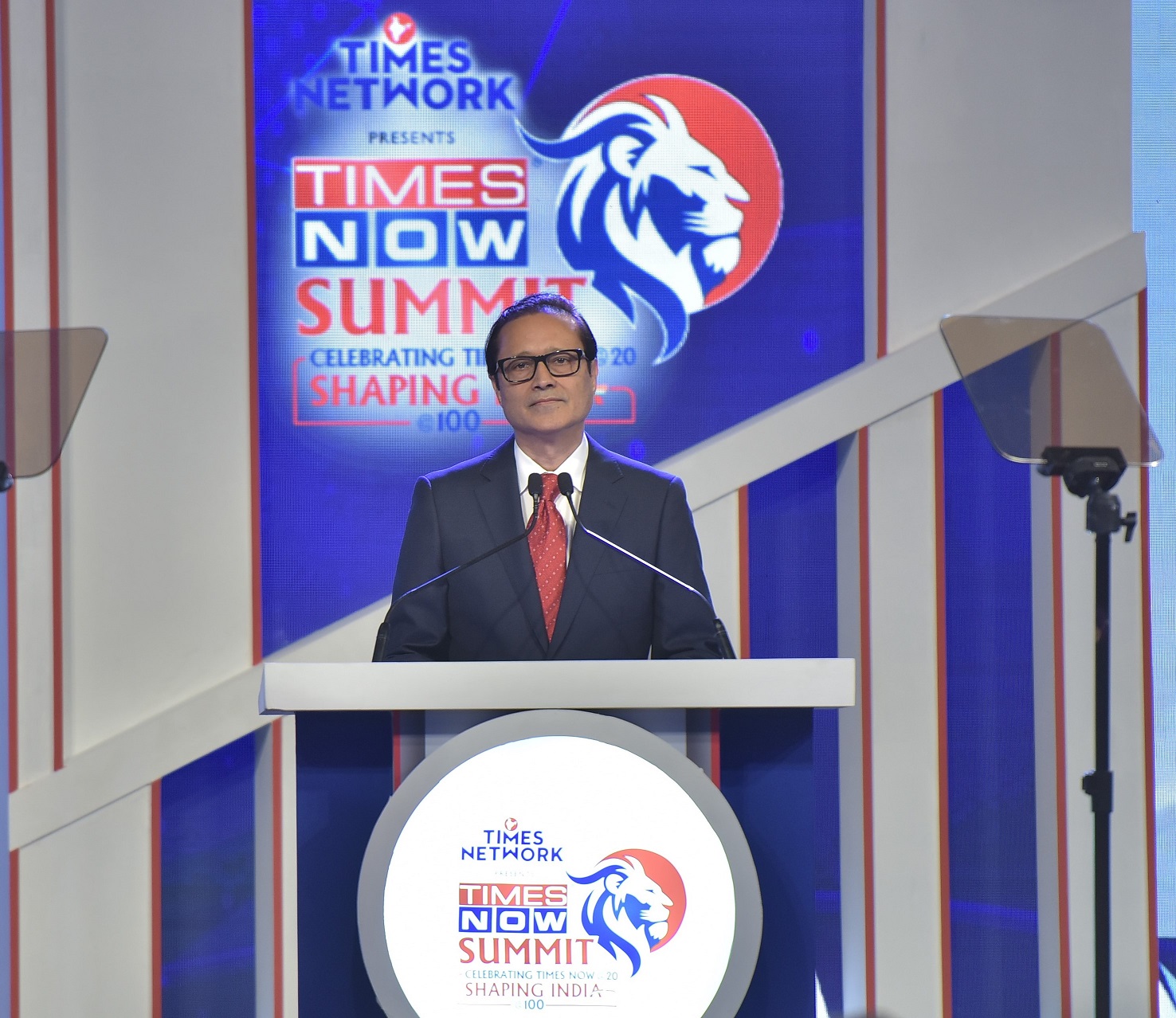
Celebrating Times Now @ 20 | Shaping India @ 100
Honourable Chief Guest
Distinguished guests…
Ladies and Gentlemen…
It is my privilege to welcome you to the Times Now Summit—a forum where ideas are tested…assumptions are challenged…and the future is shaped with intent.
This year, the summit carries a larger meaning. Yes, we mark 20 years of Times Now. But this gathering is not only about a legacy built.
It is about a century in the making. It is about Shaping India at 100.
Milestones matter. But nations are not transformed by anniversaries.
They are transformed by ambition….by clarity………and by the courage to think beyond the immediate.
India stands today at one of those defining moments in history—a moment when economic momentum, demographic energy, digital capabilities and geopolitical relevance have converged.
A nation once seen as full of promise…is now increasingly seen as central to the future of the world.
And yet, the real question before us is not what India has already become.
The real question is— what must India still build… to become the nation it is capable of being by 2047?
The road to India at 100 cannot be shaped by growth alone. It must be shaped by resilience. By strategic depth. By institutional confidence. And above all… by self-belief translated into national capacity.
That is why the vision of Aatmanirbhar Bharat is not a slogan for the present moment. It is a doctrine for the future. Self-reliance does not mean isolation. It means strength.
It means that India must be deeply connected to the world—but never structurally dependent in areas that define sovereignty, security and long-term competitiveness.
In the years ahead, self-reliance must go far beyond manufacturing and extend to the commanding heights of the twenty-first century.
India must build self-reliance in artificial intelligence—
because AI will shape productivity, security, knowledge and power.
India must build sovereignty in data—
because the nations that own, govern and ethically deploy data will shape the architecture of future.
India must build self-reliance in education—because no nation can aspire to leadership if it continues to import capability while underinvesting in its own human capital.
India must build self-reliance in defence—because strategic autonomy is only credible when backed by indigenous strength.
India must build self-reliance in energy— because no nation can claim sovereignty if the fuel of its economy remains hostage to foreign supply chains and the volatility of energy markets.
India must build self-reliance in critical minerals— because the green transition, technology revolution, and high-tech defence capabilities will be won or lost on access to the materials that power them.
India must build self-reliance in critical technologies— because the nations that design, manufacture and control the foundational systems of the modern world will set the terms on which all others must operate.
And India must build self-reliance in the realm of digital platforms and social media—because the global conversation of the future cannot be mediated entirely through systems designed and controlled elsewhere.
These are not separate ambitions. They are part of one larger national imperative—to ensure that India is not merely a large market in the global order…but a rule-shaper, an innovation leader…a producer of ideas, technologies and institutions.
For decades, India was described as a country of immense potential.
But potential, by itself, does not change history. Reform does. Execution does. Bold institution-building does and sustained national focus does.
That is why this decade matters so profoundly. Because India has a window of opportunity that will not remain open forever.
We must, quite simply, grow rich before we grow old.
This is not merely an economic argument. It is a civilizational urgency.
India must use its demographic advantage while it still has it—
to create wealth…
to expand jobs…
to deepen skills…
to raise productivity…
and to build social systems strong enough to support future generations.
The ambition of becoming a developed nation by 2047 will require hard choices. Second -generation reforms. More competitive institutions. A stronger innovation culture. Faster urban transformation. Greater investment in research. And a public discourse that rewards long-term thinking, not just short-term reaction.
That is why The Times Now Summit matters.
Because shaping India at 100 is not the responsibility of only the government or, the industry or citizens alone.
It is a shared national project. The role of a platform like Times Now, therefore, must also evolve with the times.
Not only to report where India stands…but to ask where India must go next.
Not only to question power…but to elevate the quality of national purpose.
And may I say, not merely to echo words, but to provide solutions and make this into a collective and collaborative national mission.
As we open this summit today, that is the spirit in which we gather.
Not simply to celebrate past achievements but to address responsibilities that will shape India’s future.
Not just to acknowledge how far India has come—but to define how far India must still go.
Ladies and Gentlemen welcome again to the Times Now Summit—
as we turn our attention to the defining question of our age:
How do we shape India at 100?
Thank You