

 The CEOs of the future will want their companies to be recognized as forces for good.
We live in turbulent times. Poverty, inequality, youth unemployment and climate change are among the challenges we are facing.
In business, CEOs have gone from being symbols of aspiration to objects of intense scrutiny. Even the younger, ‘cooler’ entrepreneurs, the kick-starters of the shared economy, are now being asked questions about the impact their companies have on society. Trust has become the ultimate currency.
Millennial consumers are driving this trend; 40% of those polled by the Deloitte Millennial Survey 2018 believe the goal of businesses should be to ‘improve society’. This is seriously worth pondering. By 2020, millennials will make up 40% of all consumers, influencing about $40 billion in annual sales.
Profit with purpose is set to become the new norm. Up to this point, social enterprise and impact investment have been driving this concept, which has somehow remained confined to a niche. Not anymore. Now, it’s all set to change: the CEOs of the future will want their companies to be recognized as forces for good.
Unilever is a good indicator of how major conglomerates might soon be developing a purpose-led strategy for their core business. Their outgoing CEO, Paul Polman, has been among the first business leaders to give a new, more profound meaning to the word ‘sustainability’, regarding it not just as the right thing to do, but an essential component of growth.
In 2010, Polman launched a ‘sustainable living development plan’. Its goals include: helping more than one billion people improve their hygiene and living conditions, reducing the impact of Unilever’s operations on the environment, and promoting gender parity in its factories.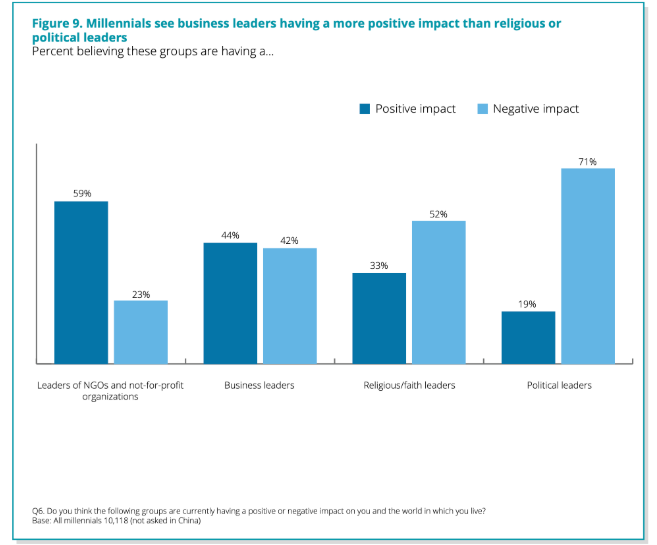
For Polman, the incentive is clear: businesses cannot thrive in a world in which people don’t. Protect people and the environment, and you will protect the future of your enterprise. From reducing packaging to halving factory water waste and distributing free health and hygiene products to remote communities, Unilever no longer has a separate corporate social responsibility (CSR) department. Instead, it has a new business model with sustainability at its core. Unilever’s net income in 2017 was $6.84 billion.
Has Polman revolutionized the sector? Not quite – but there is certainly an emerging trend for more corporates to take sustainability issues seriously, and changing their business strategies accordingly.
Take the rise of ‘B Corporations’. These are companies certified on the basis of social sustainability and environmental performance standards. Launched in 2006, the B Corp movement was historically made up of small and medium-sized companies. It now comprises more than 2,600 businesses across 60 countries, and increasingly includes larger multinational companies such Patagonia and Innocent Drinks, fully owned by Coca Cola since 2013.
Danone, one of the world’s largest food companies, has made a public commitment of becoming a certified B Corp by 2030. Its CEO Emmanuel Faber is on a mission to “re-establish trust with employees, consumers, partners, civil society and governments”. His vision of ‘One Planet. One Health’ addresses the intersection of food sustainability, health and the environment. As one example, Danone now analyzes the habits and health issues of its customers in 52 countries and adapts its products accordingly. It recently added vitamins to one of its best-selling cheeses after researching the diets of young people in Brazil.
We are at a critical juncture. According to last year’s Edelman Trust Barometer, 64% of people globally expect CEOs to lead on social change rather than waiting for government intervention. And a significant 84% expect CEOs to influence policy debates on social issues. Overall, trust in business (52%) remains higher than global trust in government (43%).
Increasingly, companies are going beyond compliance. Nearly 90% of the world’s biggest companies are reporting on their sustainability performance, using metrics established by the GRI (The Global Reporting Initiative, established in October 2016). Nearly 9,933 companies from 160 countries are currently members of the UN Global Compact – an initiative launched to align businesses’ strategy with social goals, and to support the Sustainable Development Goals. Corporate responsibility is going mainstream.
So will the future of big business be modeled on social enterprise? It may not be too unrealistic. Investors are also signaling a desire for social impact alongside a financial return. A recent survey of high-net-worth millennials found 69% place greater importance in investing in companies showing a high level of corporate social responsibility. Globally, responsible investing is booming, up 25% over the past two years to the tune of $23 trillion, according to the Global Sustainable Investment Alliance. In addition, the global green bond market – created to fund projects that have a positive environmental or climate benefit – was estimated to reach up to $300 billion by the end of 2018, nearly double its value in 2017.
It’s becoming increasingly evident that the world’s most pressing problems cannot be solved by governments or civil society alone. It’s time for business to pitch in. From reducing environmental impact to contributing to healthier societies and fighting forced labour, companies can achieve tremendous results if they balance profit and purpose. As stated in the B Corp Declaration of Interdependence, it’s all rooted in the concept of ‘do not harm’ and ‘benefit all’.
With the growing trend for investors and consumers to buy into companies that deliver positive social change alongside financial returns, the trend for big business to adopt impactful social missions looks set to continue. The question is: how many business leaders will have the courage to step up to the plate? The business of changing the world is in their hands.
Authored by Antonio Zappulla, Chief Operating Officer, Thomson Reuters Foundation