
 As marketing automation has become more mainstream, the barriers that businesses experience are also clearer.
Expectations from marketing automation platforms have not matched reality. Prior to adoption, companies imagine marketing automation software to be out-of-box solutions that can completely overhaul their marketing with very little effort
The reality is that marketing automation tools are not simple plug and play tools.
You need to invest time and resources to generate returns just like any other operations system that your business adopts.
To see high returns from marketing automation systems you need:
– a clear strategy of how the automation platform fits into your overall marketing
– knowledge of marketing automation and data management practices
– resources who can manage and scale the automation system
Companies continue to invest in automation platforms without realizing the investment required in resources to make it successful.
A 2019 report by Smart Insights identifies Data, resources, talent and strategy as top barriers to success of marketing automation implementations.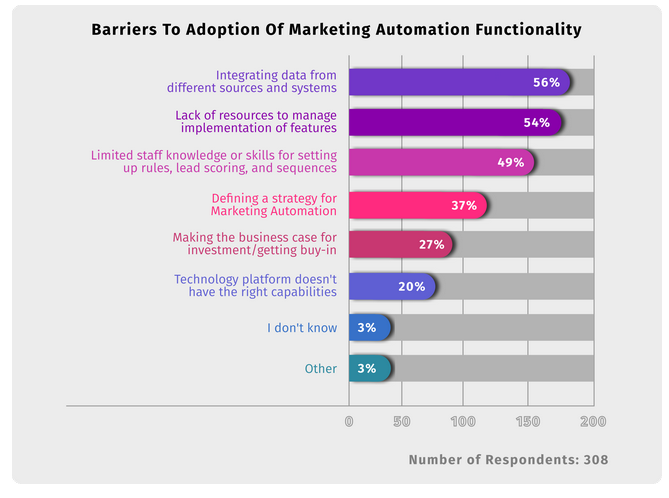
Email marketing campaigns remain the primary objective
London Research reports that even though 86% of companies are using email campaigns as a primary activity, less than one third are using features that make automation platforms truly valuable – behavioral scoring, lead nurturing and predictive personalization.
By not using these core features, the marketing automation system is reduced to merely a campaign launcher. And there are cheaper, simpler tools out there that let you blast email campaigns.
Why spend so much on marketing automation? The purpose of automation platform is to automate processes.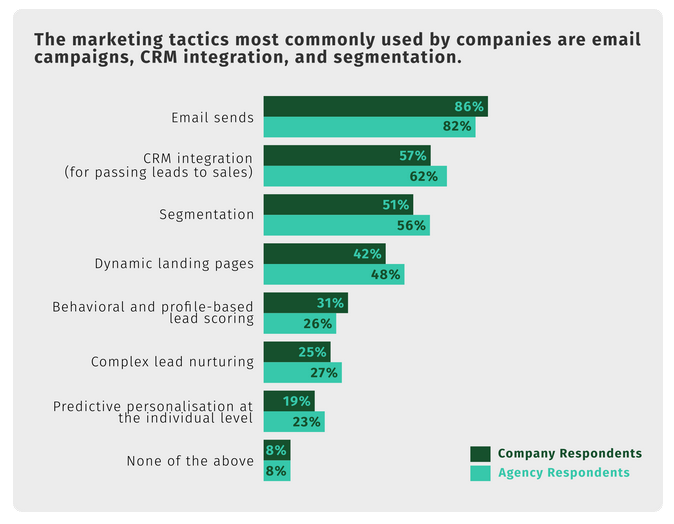
Our real-world experience of working with businesses from all over the world also validates these challenges. Throughout our journey we’ve asked ourselves – what’s the difference between companies that see great results from marketing automation and those for whom the impact is underwhelming?
We continue to see a massive opportunity for companies to better utilize their marketing automation capabilities. This can supplement or even replace decisions based on legacy knowledge or intuition.
From our experience, we recognized 4 things that successful companies do best to optimize their marketing automation ROI.
Define a clear data management strategy
Success with marketing automation relies on accurate, complete and valid data. Good data practices ensure customer information stays relevant.
An ad-hoc approach to data is detrimental as it creates pools of low quality, junk or irrelevant data. These pools become indistinguishable from good quality data. When you try and run campaigns on these mixed data sets, you are unable to cleanly separate bad data from the good. This leads to poor ROI as you don’t even know which users deserve your attention.
Lack of data strategy also severely limits automation capabilities as it makes it harder to identify actions taken by customers. Thus, it becomes impossible to segment users into relevant buckets for creating personalized nurturing campaigns.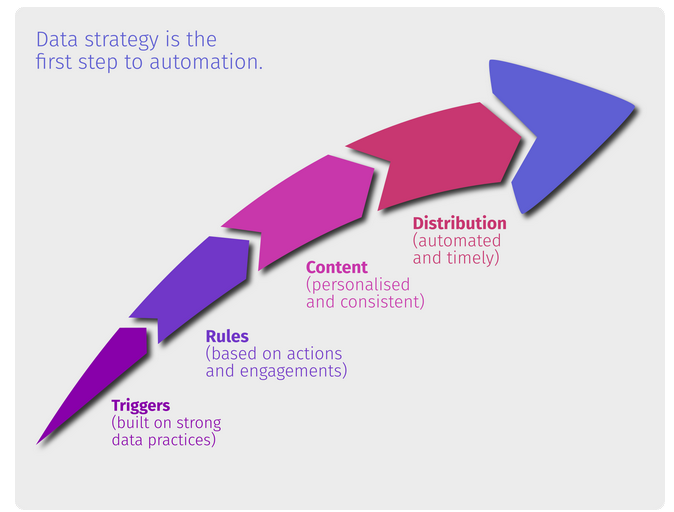
You can start building a data management strategy by taking 3 key steps:
Setup data hygiene standards
It’s important to prioritize quality of data at every stage. Letting data hygiene slide even on a few occasions can snowball into bigger challenges. Over time your growing marketing database becomes harder to sanitize – simply because of the sheer volume.
Hygiene process begins when you first use the automation platform. At the early stage you can take steps to stop junk and irregular data from making its way into the automation system. Any lists you upload must be cleaned prior.
As you execute marketing campaigns, and more data gets generated, hygiene management must continue. To encourage compliance, you can setup guidelines and share them with the team. Some basic ones to start with are:
– Exclude junk or test emails – if a few test emails need to be added, they must be appropriately flagged using a ‘lead status’ or ‘source field’ set to ‘Test’.
– Reject irregular characters – create forms that reject invalid phone numbers, public emails or randomly typed strings letters. You can automate this detection.
– Pre-validate contact details – upload emails that have opted-in, have not hard bounced and are valid (they can receive emails). You should implement OTP verification for phone numbers and link verification for email addresses.
– Upload external opt-out lists (if any) – if you are switching from another platform you can import the historical opt-out list to the new system. You can also choose to purge such data permanently prior to uploading it.
Once a month or quarter, review your data and see if there are any loopholes which are adding bad data in the system and include new guidelines to keep it out.
Add and customize fields to segment users
Users interact uniquely with your business. Each user takes different actions at different times. Some may take weeks to make their first purchase, while some may buy on the first day. You must be able to distinguish them based on the actions they take so you can setup different ways to convince them.
This is where one of the most underused features of marketing automation can help – custom fields. Most platforms have a few pre-defined fields for segmenting customers, but you can also add new fields to reflect your business process.
Once you add or customize the fields you need, setup workflows to change their values as your users interact with your business. These fields become identifiers of user behavior. They indicate which users are at what stage of their journey with your brand.
Here are some fields you can define to start with:
Source – which channel or program was the origin when you acquired the user
Source history – which channels were touched on their journey before sign-up
Lead status – identify whether the contact is new, in a stage of nurturing, is a returning customer, is a high value customer. is invalid, and so on.
Engagement level – define a scale or score to measure user’s overall engagement – a sum of all his/her interactions
Let’s take a quick example. Assume you create a field that tracks the first purchase of a customer and sets its status from “Signed up” to “Made first purchase”. Then you set up a nurturing flow that automatically detects when a user is set to this status. The system then sends a series of emails and notifications over a week to convince the user for the next purchase. Similarly, you can set up flows for inactivity, abandoned carts, category stickiness – the possibilities are endless.
Fine-tune the strategy as your business grows
Revisit your data strategy at regular intervals to ensure everything is working as desired and make changes if necessary. Reviews scheduled once a month or once a quarter are enough for most businesses.
During these reviews your team can set aside time to clean data that escaped the agreed standards.
As you discuss gaps in the policy and make changes you can also make enhancements such as adding new fields or value, proposing new standards and rethinking some of the automation processes.
Build a deep understanding of your customers
Collecting data on your customers is important but it’s rarely the complete picture. It’s just as important to pin down their behavior. 70% of marketers struggle to create a unified view of their customers’ behavior.
As the graphic below from a research by McKinsey & Company shows, returns from deep personalization are growing rapidly regardless of the industry you operate in – retail, travel, CPG, banking or any other.
Investing in understanding your users, with a mix of data and behavior, is essential to offering deep personalization that people are becoming accustomed to.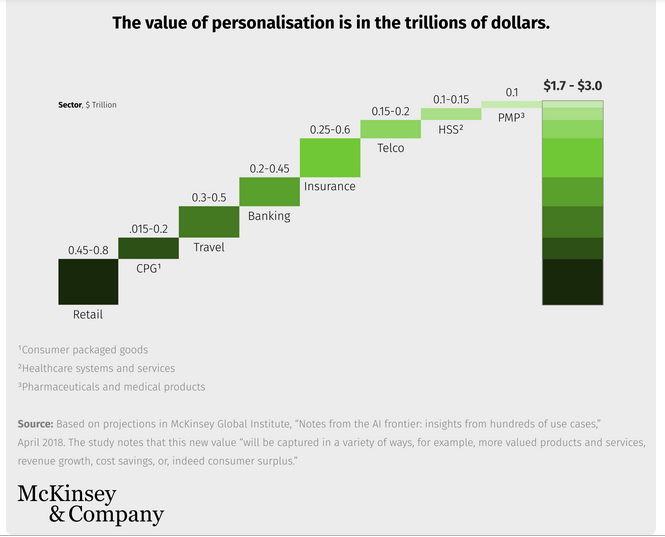
Marketing automation platforms can take you closer to fully understanding your customers. They combine static demographic data with behavioral signals to clearly identify unique purchase patterns that require personalized content.
Lead scoring is a classic mechanism for this. It’s one of the core features of any automation platform.
To setup lead scoring, you assign scores to every foreseeable customer activity. Then you set up rules to tell the system how to change the total score of a customer based on different actions. Once the rules are set the process is automatic.
For example, you can add 5 points if they click on an email campaign. Add another 30 points if they make a purchase. This way a customer’s total score is a cumulative measure of their engagement with your brand.
As the score changes based on user actions, you can setup milestones that trigger branches of nurturing flows to engage them further. This is an ideal way to understand behavior as buyers with similar preferences will gravitate towards the same nurturing flows. You can target these groups with even more specialized content.
Track this process regularly to adjust the score and add/remove actions as your users keep maturing.
Progressive profiling is another great tool to create frictionless experiences.
For users with strong engagement scores you can progressively request their information in phases rather than all at once. This makes the experience less overwhelming for the user.
During acquisition, for example, you only ask for their name and email. As they take more steps that require additional info, you append those pieces to build their complete profile.
Retailers like Amazon do this well. They ask users for shipping, payment and credit information only when they reach those steps. Progressive profiling improves acquisition rate as users are not as overwhelmed. It also promotes a more seamless experience and gives them greater control over their personal information.
Think multi-channel, multi-touch campaigns
Online purchases are becoming more complex with an endless stream of information available to users. Buyers comprehensively research and compare products before finalizing a purchase, but they also transact more often with brands that maintain an ongoing interaction.
Companies who understand their users better can maintain these interactions with automated content sent over a mix of channels – email campaigns, SMS marketing, push notifications, in-app messages, etc.
As an example, for buyers who just made their first purchase, you can setup an automated flow of 3 email campaigns, at 1-day, 3-day and 5-day intervals, with recommendations for the next purchase. You can include products from the categories that the user already browsed or additional recommendations based on what other buyers purchased. This is a great way to enhance your interactions with the buyer using personalized content.
There are endless ways of designing nurturing flows over email, SMS, notifications and other available channels. Some basic ones are:
Welcome and on-boarding series – welcome users and offer ideas for their first purchase
Cart Abandonment flow – remind users that they have items in the cart and include suggestions for other products they can combine with their purchase
Event flows – designed around birthdays and anniversaries to create brand loyalty
New category flow – sent to buyers that don’t respond to existing flows. You can use experimental content to measure their response.
The benefits of automated multi-touch campaign are clear. One, it keeps your brand name in active memory of buyers. They are more likely to buy from you if they remember you.
Second, it builds trust and loyalty. Users enjoy personalized recommendations and start building an affinity towards brands that they feel truly understand their preferences and choices.
Finally, it makes your marketing more efficient. As you can automate a series of touches with a large percentage of your users your team has more time to create content and improve underperforming campaigns.
With multi-channel, multi-touch campaigns you will start seeing results that are closer to your expectations from the automation platform.
Manage and grow your marketing operations
Ultimately, you must realize that none of this is a one-time fix. There is a reason marketing automation companies charge thousands of dollars for ongoing consulting.
As a platform, marketing automation gives you all the tools, but you must put in the time and effort to customize and extract value from it.
Companies that generate maximum returns from their marketing automation platforms strive to continuously improve it. Treating it as an ongoing project is necessary.
You can assign a dedicated marketing operations team to manage and grow the automation platform. This team can work with your wider marketing teams to ensure that data, automation, tracking and reporting processes support marketing programs smoothly.
Additionally, they can identify gaps and improve those in short sprints.
If it’s not possible to assign dedicated resources to marketing operations, you can allocate 10-15% of time of your marketing team at regular intervals for improvement. This can be done for example, once a month, once a week or a few times a quarter depending on your scale.
Marketing automation maturity is a journey that takes time and resources, but the results are worth the effort!
Companies that are successfully using marketing automation platforms have grown exponentially. Remember to start small, do the right things, and keep improving.
Written by Avadhoot Revankar,Chief Growth Hacker & Product Evangelist at Netcore.Avadhoot carries extensive knowledge in the MARTECH & Mobile Marketing space.
This post was originally published on Netcore Smartech. Click HERE for the original article