
 Gender discrimination, workplace bias, limited growth and development opportunities, tokenism, policy gaps remain roadblocks for growth of women in the communications industry
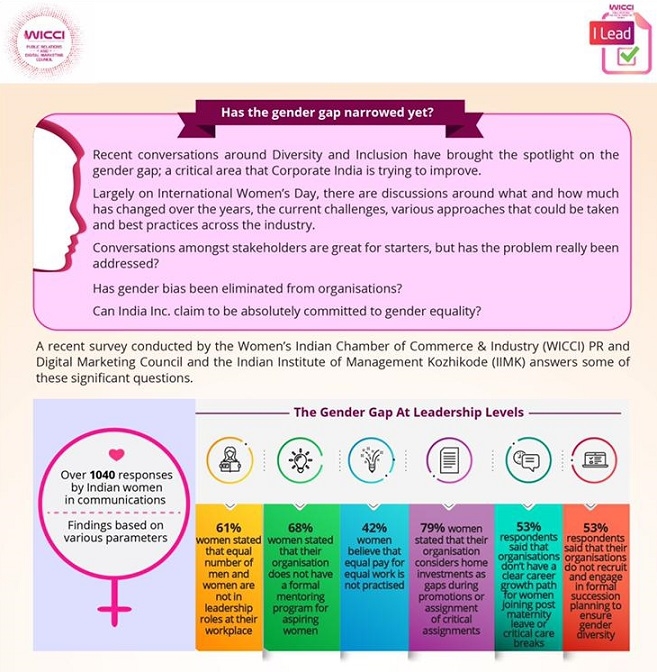
• Less than half (42%) women believe that equal pay for equal work is not practiced
• 53% respondents said that organisations don’t have a clear career growth path for women joining post maternity
• 79% women stated that their organisation considers home investments as gaps during promotions or assignment of critical assignments
Women’s Indian Chamber of Commerce & Industry’s Public Relations and Digital Marketing Council and leading B-School, Indian Institute of Management, Kozhikode (IIMK), today announced the findings of the first edition of the ‘I Lead’ survey – a collaborative study launched to capture the experiences and challenges for women to reach leadership positions in the field of communications. The study also reports the progress made so far by organisations and offers a framework that organisations can adopt to move towards a gender-inclusive workplace.
The ‘I Lead’ survey conducted in early 2021, received an overwhelming response from 1000+ women communication professionals (across genres of Journalism, Advertising, Public Relations, Digital Communications, Content Writing, Corporate Affairs and Corporate Communications).
As per the recent World Economic Forum’s (WEF) Global Gender Gap report of 2021, this year India slipped 28 places, and was ranked 140 among 156 countries, indicating the need for enabling policies to support women in the workforce. In the communications industry, despite women already forming a very large part of the workforce, almost 34%, compared to a national average of 14%, the ratio drops to just 11% at senior management positions, and a mere 3% in boardrooms.
The findings of the recently launched ‘I Lead’ survey corroborate this reality. Less than half (42%) women believe that equal pay for equal work is not practiced. Two third (68%) respondents stated that their organisation does not have a formal mentoring program for aspiring women leaders. More than half (53%) respondents said that organisations don’t have a clear career growth path for women joining post maternity leave or critical care breaks. 79% women stated that their organisation considers home investments as gaps during promotions or assignment of critical assignments. More than half (53%) respondents said that their organisations do not recruit and engage in formal succession planning to ensure gender diversity. The study indicated a mere tokenism approach exists currently, with Diversity and Inclusion policies being more of a ‘tick-in-the-box’ with little ability to eliminate gender discrimination, increasing instances of workplace bias and deep routed sexism, limited mentoring and training support, and lopsided HR policies. These startling numbers re-emphasize the need for the communications industry to walk the talk of creating an inclusive and equitable work environment for women.
Kavita Lakhani, Director Operations, Weber Shandwick and National President, WICCI Public Relations and Digital Marketing Council said, “While 66% respondents of the survey agreed to the existence of gender diversity at their workplace, 61% respondents stated that equal number of men and women are not in leadership roles. The ‘I Lead’ survey underscores the need for a gender inclusive culture that enables high-performing women to grow into leadership roles – and above all have complete control and freedom to drive their career journeys in the direction they desire. To empower more women to reach the top, organisations must expedite action in three key areas: modeling leadership and building confidence through role models/networking, progressive policies, and support systems to nurture ‘women of future’ and providing corporate development programs that propel qualified women who aspire to lead. It is my fervent belief that this study will inform and encourage leaders to take clear and decisive steps to develop the leadership potential of their female employees – and that we will all be stronger for it.”
Prof. Deepa Sethi, Chairperson, PGP-LSM, IIM Kozhikode, and the Project Coordinator said, “It is high time women are treated equally. Diversity and inclusion policies need to be implemented in true essence. Women are not asking for special treatment, nonetheless they do deserve equal treatment in every aspect of work including their climbing the ladder to the leadership roles. Success stories are not written on paper, these are engraved in human minds through the way we transact with each other as individuals. The ‘I Lead’ survey is an attempt to put together a framework towards a healthy workforce and is grounded on perspectives from women in the PR and Communications industry in India.”
The ‘I Lead’ survey also captured the progress made by companies in recent years towards ensuring gender diversity, clearly indicating some big wins. Two thirds of the respondents (68%) women said that male and female employees are evaluated on equal parameters. 67% participants accepted that their organizations value and nurture ambitious women. More than half (63%) respondents affirmed that women are provided with upskilling opportunities. 7 in 10 (74%) women agreed that their organisations encourage them to speak up against workplace discrimination/harassment, clearly indicating a commitment to building a safe and inclusive culture.
The WICCI PR and Digital Marketing is committed to play an instrumental role in sensitizing stakeholders, for enduring and impactful change. Towards this end, the ‘I Lead’ survey recommends a transformative framework (known as OTS) in view of three gaps identified at policy, skillset, and mindset level, clearly indicating the need to restructure and together introduce a change mechanism for the industry.
• Organisational Policies (O): Creating inclusive, realistic and impact driven organization policies that are designed to support ‘women of future’ need to be the foundation of a workplace that is truly committed to diversity and inclusion.
• Training, mentoring and development (T): Focusing on sustained and comprehensive training, development, and mentorship programs for women at different stages in their career journeys, including those returning to work post maternity, sabbatical or a career break.
• Support system (S): Enabling an inclusive workplace culture, while creating independent support network groups, both at an organizational and industry level, will help women employees be heard without being judged. Additional responsibility lies with human resource departments, consultancies, and recruiters to ensure ‘equal pay’ is a reality for women, at different stages of their careers.