

 Preferences Vary Greatly Around the World
As connected commerce continues to gain momentum globally, it’s increasingly important that retailers make online shopping as simple as a routine trip to the store, even if consumers are browsing from the other side of the globe. Nielsen’s Global Connected Commerce Survey found that 57% of online respondents in the study who made an online purchase in the last six months say they bought from an overseas retailer, so catering to the needs of consumers near and far is critical—and offering them the right method of payment is no exception. The simple truth is that the online consumer is just a click away from abandoning their virtual shopping cart. So what’s in your customer’s digital wallet? It depends on where you ask.
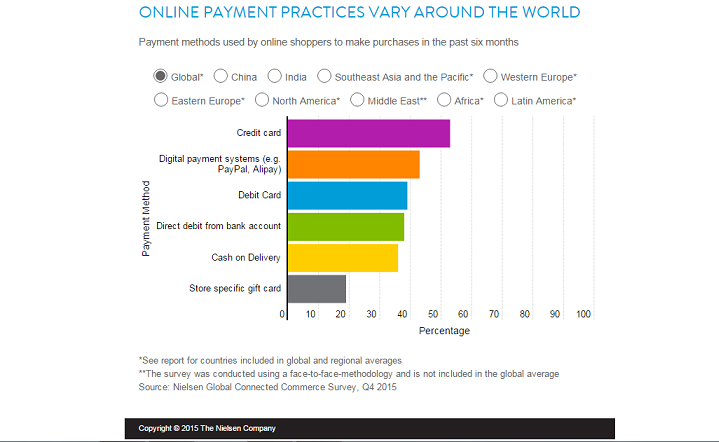
Around the world, credit cards are the most commonly used payment method. More than half of online respondents who say they’ve shopped online during the past six months paid with a credit card (53%). In addition, roughly four-in-10 used a digital payment system like PayPal or Alipay (43%), debit card (39%) or direct debit from their bank account (38%). While these methods are the most used around the world, there are notable differences across countries.
Respondents in the U.S. and Canada say they prefer paying with credit cards by a wide margin. During the past six months, 66% of U.S. online shoppers and 81% of Canadian online shoppers say they paid with a credit card, well above the percentage that used the next closest option—debit card in the U.S. (38%) and digital payment systems in Canada (41%). Credit card is also the most used payment option cited in several Latin American countries in the study (52% – 80% across the countries) and Japan and Korea (76% and 79%, respectively).
The use of digital payment systems in China is extremely popular. Eighty-six percent of Chinese respondents say they paid for online purchases during the past six months via digital payment systems. This is also the most widely cited option in several Western European countries, including Germany (68%), Spain (56%) and Italy (55%).
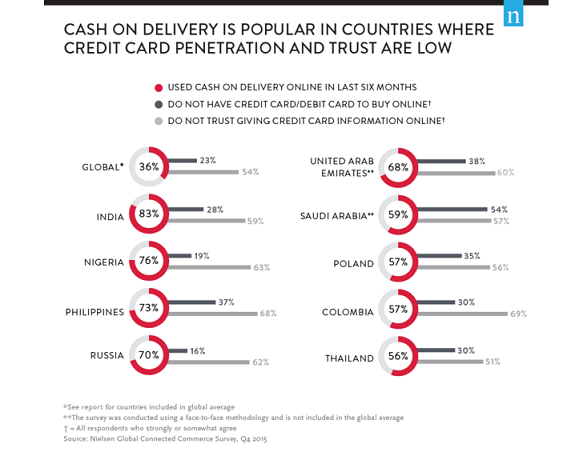
Cash on delivery is a popular choice in India (83%) and many other developing markets, including Nigeria (76%), the Philippines (73%), Russia (70%), United Arab Emirates (68%), Saudi Arabia (59%), Colombia (57%), Poland (57%) and Thailand (56%). Similar to India, most of these countries have below-average (self-reported) credit card ownership or below-average trust in providing credit card information online.
“An ideal payment gateway has two core characteristics: It is secure, and it allows consumers to pay with whatever method fits their needs (and wallets) best,” said Patrick Dodd, president, Nielsen global retailer vertical. “Not every payment method works everywhere. Retailers looking to expand internationally need to understand local market nuances and cater their offerings accordingly. Increasing the number of available payment options can improve the odds of converting browsers to buyers. In the long run, however, for e-commerce to really take off, it has to migrate upwards from cash on delivery. To build trust in online transactions, retailers need to educate consumers about the steps they’re taking to protect their personal information, and they must find ways to deliver a better experience than what consumers get from cash. Potential solutions include providing incentives or discounts for paying online or via mobile payment systems.”
Other findings from the recent Global Connected Commerce report include:
Fifty-seven percent of online respondents in the survey say they purchased from an e-tailer outside their country’s border in the past six months.
Nearly half of online respondents in the study (49%) say they shop online to get grocery products they can’t find in physical stores.
More than half (57%) of online respondents say they have doubts that e-commerce sites will keep their personal information secure and confidential.
Six-in-10 online respondents say they’ll only shop online for electronics (62%) and mobile products (61%) if it saves them money.
About The Nielsen Global Connected Commerce Survey
The Nielsen Global Connected Commerce Survey was conducted between August and October 2015 and polled more than 13,000 consumers in 26 countries throughout Asia-Pacific, Europe, Latin America, the Middle East, Africa and North America. The sample for all countries except Saudi Arabia and United Arab Emirates includes Internet users who agreed to participate in this survey and has quotas based on age and sex for each country. It is weighted to be representative of Internet consumers by country. Because the sample is based on those who agreed to participate, no estimates of theoretical sampling error can be calculated. However, a probability sample of equivalent size would have a margin of error of ±0.9% at the global level. This Nielsen survey is based only on the behavior of respondents with online access. Global and regional averages used in this report are based on weighted country data. Internet penetration rates vary by country. Nielsen uses a minimum reporting standard of 60% Internet penetration or an online population of 10 million for survey inclusion. In Saudi Arabia and United Arab Emirates, a face-to-face methodology was used for nearly 1,000 respondents. Given the differences in methodologies used, results from the Middle East are not included in the global average.