 The closure of Asian streaming service Hooq is a reminder that OTT video is an incredibly difficult business, and reminds us that the history of the internet is one littered with failed video services.
Omdia view
The closure of Asian streaming service Hooq is a reminder that OTT video is an incredibly difficult business, and reminds us that the history of the internet is one littered with failed video services. To succeed, OTT video services must have access to a steady source of capital in order to pay for new and exciting content, use a decent technology stack, and offer reliable customer services. Companies must also regularly advertise to drive a flow of new users to the service. Even if a company has access to the funds to do all of this, there is still no guarantee of success. Fundamentally, without long-term contracts and without being tied to other products and services (such as pay-TV, mobile, or broadband contracts), OTT video services remain at the mercy of subscriber loyalty, which is extremely difficult to generate.
Five years after launch, Hooq had only just managed to break the 1 million subscriber mark (in 2019), and that’s across five markets, which is not a particularly good result for a streaming service with the backing of telco giant Singtel plus two major US studios. In its largest market, India, Hooq struggled to break out from market irrelevancy, never achieving a market share over 1%. Elsewhere the service fared slightly better – particularly in the Philippines where it was second only to Netflix – but in most markets, Hooq was largely stuck in a battle for minority market shares with arch-rival Viu. Singtel’s US partners Sony and Warner Bros have their own vested interests in streaming services, and they’re getting a whole lot smarter with their online video properties. Sony just closed its vMPVD service PlayStation Vue in the US for underperforming, while AT&T’s WarnerMedia division is readying its own slate of services including HBO Max. Sony and Warner will therefore have questioned the wisdom of keeping an underperforming Hooq running. The precise details for its closure remain scant, but there were signs that Singtel’s partners had been deprioritizing their investments in Hooq lately, and plausibly if either or both US partners decided to pull out, and then that would of course explain the closure of the service. Regardless, poor subscriber uptake five years in does speak for itself.
We’ve long said that the 2020s and the coming of multiple next-gen services like Disney+, HBO Max, and others will make for tougher times for many local and regional streaming services. Consider that most services today were launched as part of the 2016 “SVOD bonanza,” when TV and entertainment companies and telcos launched streaming services hoping to cash in on the hype around Netflix. Many of these services were built to cater to a sort of a side-business, that would exist next to flagship TV and operator services. For a few years these SVOD services did serve a good purpose – principally by allowing operators to sell to new demographics – but five years on, very few such operator services have managed to confidently compete against US majors like Netflix and Amazon. With multiple new US next-gen services coming, the pressure is on for local and regional services to quickly upgrade and truly become competitors at a mass-market level (i.e., with subscribers in the tens of millions, as opposed to hundreds of thousands). This will require a lot of investment, but also the will to succeed: operators must abandon the idea that OTT video is some sort of side business, and those that don’t are likely to fail.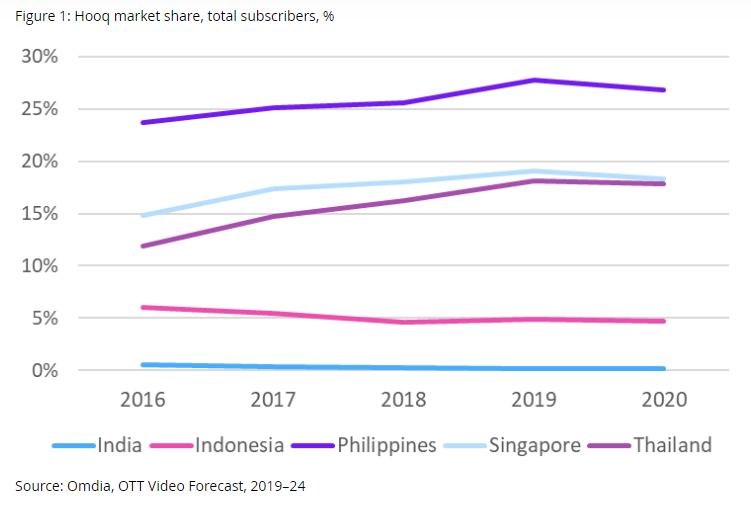
That’s not to say there won’t be enough room for multiple types of streaming services in the 2020s, both big and small. What will be different in the coming years is that services will opt for different business models. Not everyone can survive using the Netflix model which relies on an ever-growing global scale. Services that are unable to compete as SVODs may instead opt for AVOD, or hybrid AVOD/SVOD. Others still may opt to become channels on aggregators such as Apple TV or Roku. Over the next few years, multiple US majors expanding outwards means differentiation will be of paramount importance.
A case in point is Quibi, which launched in the US this month (April 2020). Built on short-form mobile-first original content, Quibi is a far cry from Netflix, Amazon, Hulu, and Disney+. As a first-mover, Quibi is a great opportunity, but the challenge is that it is launching in untested territory. Focusing on younger demographics makes sense – but will they be prepared to pay for the service? Launching with a basic tier of $4.99 per month with adverts ($7.99 without) isn’t particularly expensive, but it’s likely to be borderline too expensive for many younger people. As a new service with a unique concept, Quibi does offer a great deal of differentiation against most other streaming services. It will be positioned with a clear and unique brand identity – complete with neat vertical/horizontal viewing tools – but will Quibi’s core brand message be picked up by younger demographics? The worry is that younger demographics are already too preoccupied with social media and video games amongst countless other distractions.
Quibi has not yet put out subscriber expectations, but if the service reaches anything between 1–3 million in year one, and if it grows to 5 million by 2021, then perhaps doubling to 10 million by 2023–24, that should count as a huge success. But to achieve this, Quibi will need to produce at least 1–3 truly successful hit shows. Quibi needs something of the social caliber of Netflix’s Stranger Things, or HBO’s Chernobyl or Succession; must-watch shows of recent years that people talk about at school and in work.
Then there is the added worry of the current global COVID-19 pandemic. We’ve already seen sky-high increases in viewing across all platforms as audiences stay at home due to the pandemic. But this does not necessarily mean that increased viewing benefits one type of service over another. So far, households with pay-TV are watching more pay-TV, while the same goes for Netflix. Similarly, we’ve not yet seen any indication that the pandemic is influencing people to switch between platforms and services. However, the pandemic has already caused most film and TV production to come to a standstill.
This means both TV and OTT video services that rely on new content will end up with fewer new titles in the second half of the year, and that risks having an impact on audience behavior. Should the pandemic slow down by summer, as everyone hopes, the general impact on media and entertainment should be balanced out by the end of the year. Until then, for operators that rely on live content – notably sports services – the pandemic will already have had a catastrophic impact. Pay attention to how services like DAZN and others are being forced to react. In the case of Quibi, it will of course have a sizeable library of content ready at launch (otherwise the launch would have been postponed). So, for some time Quibi won’t necessarily be negatively impacted by the pandemic, but what happens in the second half of the year if there is not a steady flow of new content added to the service?
Source: Omdia