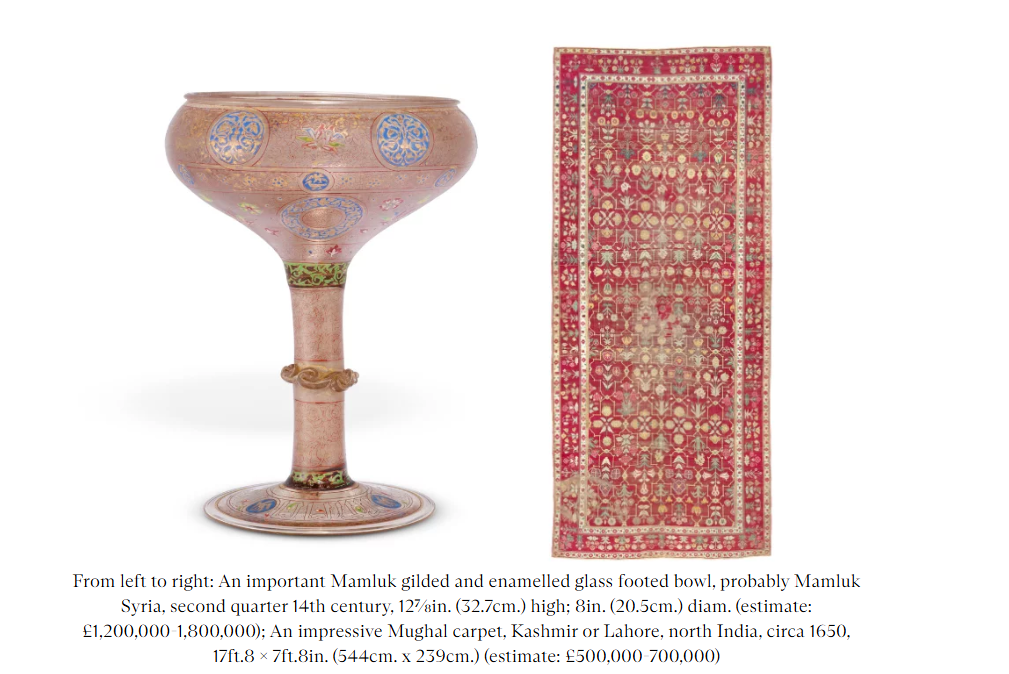
Showcasing a broad array of exceptional works of art, Christie’s Art of the Islamic and Indian Worlds including Rugs and Carpets in London on 30 April will be a highlight of the season. Masterful craftsmanship is exemplified by an extremely rare Mamluk gilded and enamelled glass footed bowl from the Golden Age of Islamic glassmaking (estimate: £1,200,000-1,800,000) and an impressive Mughal Indian ‘Flower and Lattice’ carpet (estimate: £500,000-700,000), which are part of a small group of five works being offered by the Toledo Museum of Art in Ohio to benefit their acquisitions fund. Rugs and carpets which trace the breadth of artistic production from Persia and the Caucasus, to Anatolia and Central Asia, include The Holms Hepburn Coronation Carpet which lay under the throne for the coronations of King Edward VII in 1902, King George V in 1911 and the wedding of H.R.H. Princess Mary in 1922 at Westminster Abbey (estimate: £30,000-40,000); it is offered from the property of a private European collector.
With works dating from the 7th to the end of the 19th century and geographically spanning Spain to India, the sale also includes manuscripts, metalwork and a group of Indian princely jewelled objects, alongside notable Mughal and Company School paintings. Kufic Qur’an folios and medieval Persian ceramics represent some of the earliest forms of Islamic art within the sale. A major highlight is a significant private collection of arms and armour. The full pre-sale public view at Christie’s headquarters in London will run from 24-29 April, alongside the exhibition of The Mary and Cheney Cowles Collection of Indian Painting and Calligraphy from 24-27 April, during Christie’s much anticipated Islamic and Indian Art Week.
Mamluk Glass
One of the rarest and most sought after materials within the field, enamelled Mamluk glass has a particular allure for collectors of Islamic art. The earliest known owner of the Mamluk gilded and enamelled glass footed bowl (estimate: £1,200,000-1,800,000) was French artist Jules-Albert Goupil (1840-84). The physical form of this bowl is rarely encountered, though frequently depicted in the blazon, or emblem, of the saqi, or cup-bearer, which is found on many surviving Mamluk objects: a silhouette of a footed bowl with a distinctive raised boss in the middle of the stem. As well as adding to the beauty of objects, applying enamel to glass was an impressive technical feat, requiring glass makers to heat the vessels sufficiently to vitrify the enamel, but not enough to melt the glass body of the object. One of this bowl’s most impressive technical feats are the three gilded animal combat groups on the upper frieze of the body, finely outlined in red. Such rarities have been greatly prized since the Middle Ages – they were given to European rulers in the age of the Crusades and Mamluk ambassadors also took glass objects as far afield as Ming China. Because of its fragility and the complexities associated with making it, such examples of Mamluk enamelled glass are scarce.
The Mughal ‘Flower and Lattice’ Carpet
A rare opportunity for the market, this imposing carpet is an important example of the new flower style in Mughal India which became popular in architectural decoration and the decorative arts under the emperor Shah Jahan (r.1628-58) (estimate: £500,000-700,000). Inspired by painstaking observation of real plants as well as contemporary European engravings, by the mid-16th century such flowers had become a mainstay of Mughal decoration and design. The particular design of the lattice on this carpet, as well as the precise drawing, allows it to be securely dated to the middle of the seventeenth century, making it a contemporary of other icons of Mughal art such as the Taj Mahal (depicted in this sale in Sita Ram’s stunning painting from 1815, with an estimate of £80,000-120,000), the Windsor Padshahnama and the Late Shah Jahan albums. The year 1620 has been identified as the crucial moment when such flowers began to appear in Indian art. In the spring, Jahangir made a visit to Kashmir accompanied by his favoured court artist Mansur, who he ordered to produce one hundred paintings of flowers, and so the Mughal flower style – which continues to be celebrated in 21st century – was supposedly born. The golden-yellow lattice of this carpet comprises an interlocking grid of eight-pointed stars and cruciform units, with flowerheads at each vertex and flowering stems centred in each one; this is similar to a long rug in the collection of the Maharaja of Jaipur.
The former owner of this carpet, Irma Nathan, married the American businessman and diplomat, Jesse Isidor Straus, in 1895. After the death of the latter’s father on board the Titanic in 1912, he became the co-owner of Macy’s department store. Irma lived until 1970, and donated parts of her collection to several American museums including the Toledo, as with the present example, and the MET. Reported to be ‘an expert narcissus cultivator’, it was perhaps this passion for flowers that drew her to this remarkable carpet.
The Holms Hepburn Coronation Carpet
The history of this 17th century Safavid carpet is woven into the ceremonial life of the British monarchy in the early 20th century (estimate: £30,000-40,000). Revered for its craftsmanship and rich palette, the carpet served as the regal foundation for three major royal occasions, including the coronations of King Edward VII in 1902 and King George V in 1911, as well as at the wedding of H.R.H. Princess Mary in 1922 in Westminster Abbey. Its presence at these landmark events has elevated it beyond a work of art, transforming it into a silent witness to moments of national significance and royal tradition. Persian carpets have been used in European royal or courtly ceremonial events for centuries as seen in the anointing of King Frederik IV in 1700, painted by Bendix Grodtschilling III (1686-1737) which clearly displays a large ‘Polonaise’ carpet, from the Danish Royal collection, between the thrones and the altar. As noted by Linda Komaroff, in HALI magazine (issue 162), the present carpet was with the prominent British art dealing brothers Henry and Joseph Duveen who were commissioned to provide both tapestries and carpets for the coronation of Edward VII in 1902. Having begun dealing in the late 1860s, they were noted as being the buyers of most of the Safavid carpets appearing on the market at the time which drove the market upwards. Following Edward VII’s coronation it was sold to the Scottish art collector John Augustus Holms (1866-1938), who later loaned the carpet back to Westminster Abbey to be used during the coronation of King George V in 1911, and the wedding of Princess Mary and Henry Lascelles in February 1922.
The sale presents a total of 88 exceptional rugs and carpets, juxtaposing tribal and village weavings with the highest expressions of master craftsmanship. A private collection of vibrant Caucasian village rugs provides an exciting opportunity for collectors, each offered without a reserve (lots 143-151). In addition, a select group of Qajar works from an important European collection includes a sumptuous and rare silk Heriz ‘Triclinium’ carpet (estimate: £35,000-45,000), together with three notable Kirman carpets of pictorial design. Woven at the end of the 19th century they illustrate the weaving prowess of two of the greatest master weavers of that period, Muhammad ibn Ja’far and master Ali Kirmani.
Arms and armour
An important private collection of Islamic arms and armour brings together works from Turkey, India, Egypt and Iran. Much of the group formed the core of landmark exhibitions in the category in Saudi Arabia (1991) and Malaysia (1994), and is distinguished by strong provenance throughout. Comprising 34 lots, and with estimates ranging from £1,500 to £120,000, highlights from the group include a rare Talpur half-suit of masked armour, Kutch or Sindh, India, late 18th or early 19th century (estimate: £80,000-120,000), a gem-set gold-mounted dagger (jambiyya) and scabbard, Hyderabad or Kutch, India, third quarter 19th century (estimate: £80,000-120,000). Another notable highlight is a pair of coral-inlaid flintlock pistols Ottoman Algeria, 18th century, that were formerly in The Rothschild Family collection (estimate: £50,000-70,000).
A sale rich in beauty and significance, other highlights include an impressive silver-inlaid copper alloy casket possibly Ghurid Herat, late 12th or early 13th century, densely decorated on each face with astrological imagery (estimate: £300,000-400,000), and an important very early fragmentary folio from a monumental kufic Qur’an, probably Hijaz, second half 7th century, which is notable for its large size and the traces of illumination on both sides (estimate: £200,000-300,000).